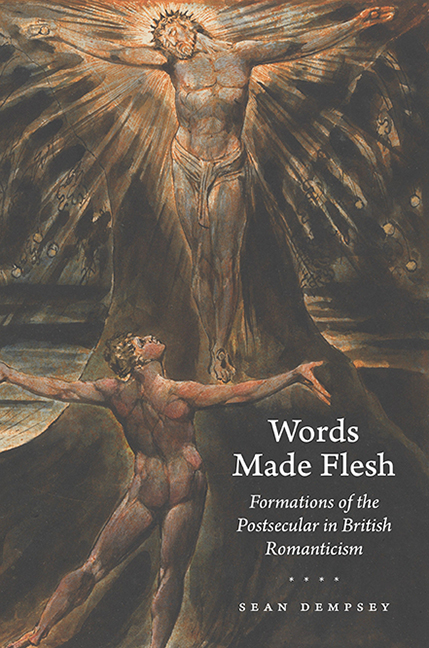
Words Made Flesh
Religion is not merely a different way of thinking but is rather an alternative manner of being—it is both a way of attending to the world and a form of embodiment. Literature provides another key to legislating new ways of being in the world. Some of the best Romantic literature can be understood as experimental attempts to access and harness infrasensible energy—affects and dispositions operating beneath the threshold of consciousness—in the hope that by so doing it may become possible to project elusive affects into the practical world of conscious thinking and judgment. Words Made Flesh demonstrates how the Romantic poets Samuel Taylor Coleridge, John Keats, and Percy Bysshe Shelley and the novelist Jane Austen affect, mediate, and ultimately alter our very sense of embodiment in ways that have lasting effects on readers’ affective, political, and spiritual lives. Such works, which unsettle habitual ways of seeing, are perennially valuable because they not only call attention to the dispositions we normally inhabit, but they also suggest ways of forging new patterns and forms of life through the medium of embodiment.
Drawing on the work of these writers, Dempsey argues that Romanticism’s contribution to our understanding of the postsecular becomes clearer when considered in relation to three timely scholarly conversations not previously synthesized: secular and postsecular studies, affect theory, and media studies. By weaving together these three strands, Words Made Flesh clarifies how Romanticism provides a useful field guide to the new geography of the self ushered in by secular modernity, while also pointing toward potential postsecular futures. Ultimately, Dempsey argues for a view of literature that recognizes it as an essential component to ethical practice.
- Coleridge ReviewA rich interdisciplinary study . . . For Dempsey, Romanticism is no bygone experiment within the history of Western thought. As he allows its literature to speak in dynamic, often open-ended ways, his study attunes us anew to the movement's potential to shed light on the aesthetic, ethical, and metaphysical stakes of our perceptual lives.
- The Wordsworth CircleBringing together postsecular studies, affect theory, and media studies, Dempsey makes a compelling argument that the Romantics pioneered several strategies and forms for grappling with secular modernity—strategies that are especially relevant in our own postsecular age of media saturation and ideological conflict.
- Joel Faflak, Western University, author of Romantic Psychoanalysis: The Burden of the MysteryWords Made Flesh is an utterly original study of the ‘sensible’ parameters of Romantic literature. Dempsey draws on an impressive range of historical, cultural, literary, critical, philosophical, and theoretical sources, between which he moves deftly and effortlessly. Potent, incisive, and at times quite moving, Dempsey’s book is at the vanguard of a critical renaissance in Romantic studies, and it reminds us that we are still only beginning to understand the Romantic ‘revolution’ in writing, thought, and especially embodied experience.
- Mark Knight, Lancaster University, author of Good Words: Evangelicalism and the Victorian NovelA rich and astute book that represents a major contribution to the field. There is much to admire in Words Made Flesh. The way that Dempsey engages with a wide range of ideas in a constructive manner is a delight to read. His understanding of the material is outstanding, and his ability to explore subtle connections between different theoretical approaches is impressive.
- Religion & LiteratureWords Made Flesh will be of great interest to scholars of British Romanticism, religious studies, and affect theory, providing a fresh and robust lens with which to understand sympathy and religious sense in Romantic poetry as well as suggesting a direction for future research in this vein.
Sean Dempsey is Associate Professor of English at the University of Arkansas.
1. Theorizing the Postsecular
2. Poetic Faith
3. Coleridge's Parable of Modernity
4. "To See as a God Sees": Keats and Cinematic Subjectivity
5. "Awful Doubt": Shelley's Tragic Skepticism
6. "Open-Hearted": Persuasion and the Cultivation of Good Humor
Coda: Postsecular Romanticism

