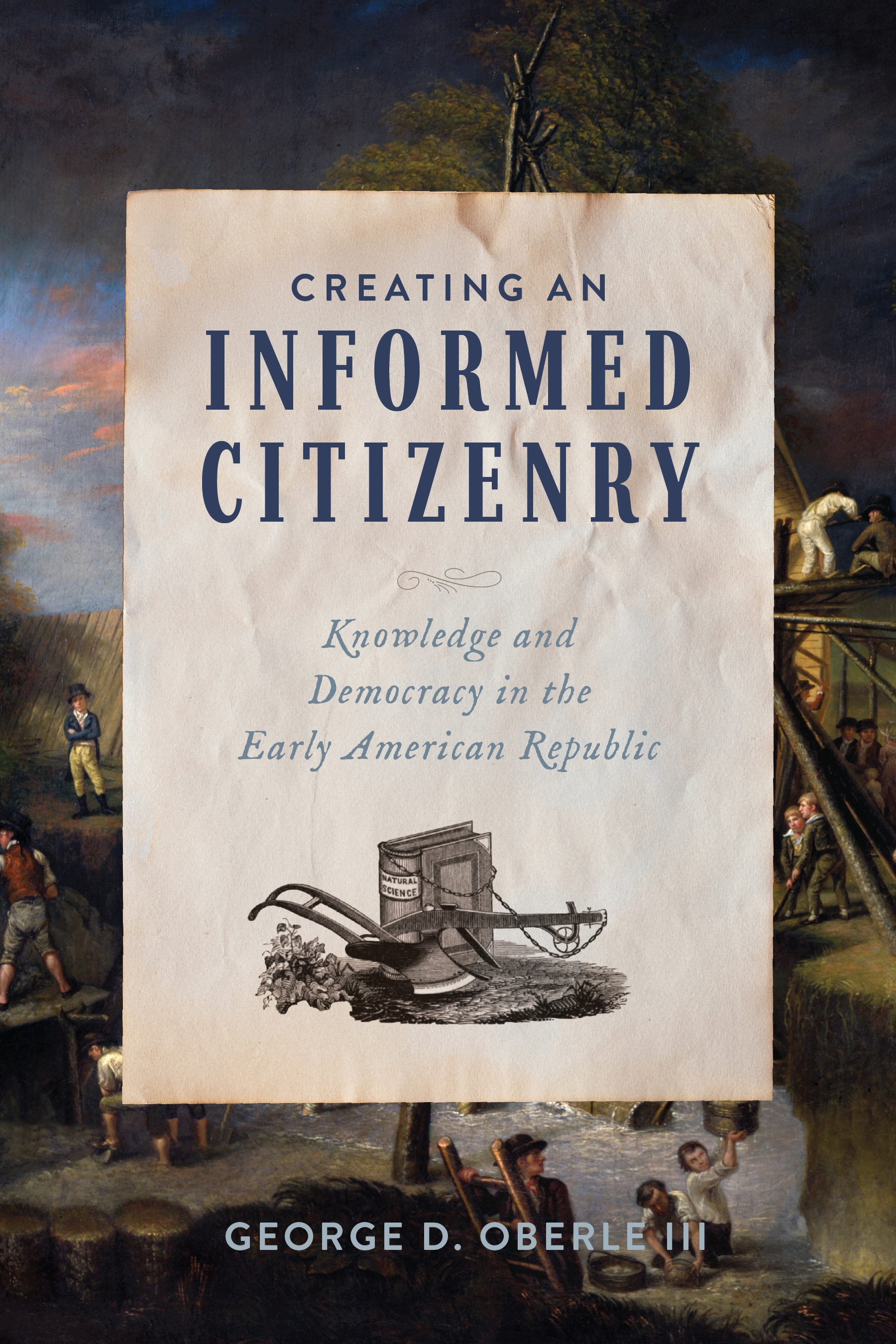
Creating an Informed Citizenry
Knowledge and Democracy in the Early American Republic
George D. Oberle III
Examining the early debates in the United States over how best to educate the constituents of the new nation
When the founding fathers of the United States inaugurated a system of government that was unprecedented in the modern world, they knew that a functioning democracy required an educated electorate capable of making rational decisions. But who would validate the information that influenced citizens’ opinions? By spotlighting various institutions of learning, George Oberle provides a comprehensive look at how knowledge was created, circulated, and consumed in the early American republic.
Many of the founders, including George Washington, initially favored the creation of a centralized national university to educate Americans from all backgrounds. Over the first half of the nineteenth century, however, politicians moved away from any notion of publicly educated laypeople generating useful knowledge. The federal government ultimately founded the Smithsonian Institution in Washington, DC, to be run by experts only. Oberle’s insightful analysis of the competing ideas over the nature of education offers food for thought as we continue to grapple with a rapidly evolving media landscape amid contested meanings of knowledge, expertise, and the obligations of citizenship.
In George Oberle’s important and timely book, we learn that from the earliest days of the republic, debates over knowledge were caught up in partisan conflict. Because different knowledge regimes could shape the kind of society they lived in, Americans’ debates over knowledge reflected different ideas about democracy itself. Like today, Americans argued over who has the authority to make claims about knowledge: the people, experts, or the government?- Johann Neem, Western Washington University, author of Democracy’s Schools: The Rise of Public Education in America
- Lindsay Schakenbach Regele, Miami University, author of Flowers, Guns, and Money: Joel Roberts Poinsett and the Paradoxes of American PatriotismWith impressive detail, George Oberle explains exactly how the United States developed the knowledge institutions that would form the civic and educational backbone of the new nation, including the world’s largest museum and research complex, the Smithsonian Institution. Indeed, we can see the roots of our current debates about what is education for and for whom? in 18th and 19th century contests over liberal versus practical curriculum, authority and access, democratization and elitism. Creating an Informed Citizenry is essential reading for anyone who wants to understand what the founding generation and their successors thought and did about creating and sharing new knowledge and how we are living with their conceptions still.
- Pedagogic HistoricaIn uncovering this broad, interconnected, contested, and adaptive network of institutions and individuals, Oberle has offered a compelling new story as to how early Americans tried to create an informed citizenry. His narrative will offer fruitful pathways for further exploration. Yet the book is also timely. Surely contemporary readers can find some commonality with those who are trying desperately throughout the book to inform rambunctious citizens amid an era of 'information revolution' (3). Whether we are broadening historical narratives to include more diverse stories, expanding initiatives related to civic education, or reviving appreciation of the classics, Americans today seem as fixated as their predecessors in the early republic on –and unavoidably at odds about – what it means to be an informed citizen. Perhaps Oberle’s book therefore offers a reminder to those who try to control either knowledge or democracy that they have both have proven to be critical yet fickle forces in the history of the United States.
- CHOICEA thoughtful historical analysis of knowledge creation that also speaks to contemporary issues and is thus of interest to a general audience.
George D. Oberle III is History Librarian, Associate Term Professor, and the Director of the Center for Mason Legacies at George Mason University.

