Peter Eisenstadt on Howard Thurman and Jackie Robinson
Related
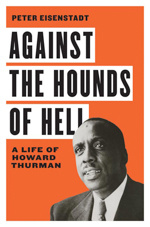

Five years ago I published a 500-page biography of Howard Thurman, Against The Hounds of Hell: A Life of Howard Thurman. A lot of people are not familiar with Thurman, and I often have to introduce him. He was an African American minister, one of the most significant American religious thinkers in the middle decades of the last century, a mentor to many civil rights leaders, and spiritual seekers of many different religions. I usually just say he was a mentor to Martin Luther King Jr., which is certainly true, but not perhaps the most significant thing to say about him, but it is the easiest way to quickly establish the bona fides of his historical significance.
I wrote a biography of Thurman in part because no one had previously attempted to write a comprehensive account of his life, and in part because I was encouraged to do so. For many years, I had been an associate editor at the Howard Thurman Papers project. The project published five volumes of The Papers of Howard Washington Thurman. I had also co-written a book about Thurman’s trip to India in 1935–36, when he chaired a delegation that became the first African Americans to meet with Mahatma Gandhi. In all, I have written, co-written, or co-edited 11 books about Howard Thurman. You might think that might be overkill, and it probably is, but then again Thurman had been relatively understudied, and little of his unpublished material had made its way into print. No biography is easy to write, but I felt I knew the material as well as anyone when I started writing it. It could have been a better book, and I have had the usual post-publication regrets, but the book was well received, and, if I can toot my own horn, the book jacket endorsements includes the glittering superlatives that every writer dreams about, “definitive,” “magisterial,” and “masterpiece.” I’m proud of what I have done to bring Howard Thurman’s legacy to a wider audience.
My new biography is Integration at Second Base: Jackie Robinson and the Quest For Black Citizenship. Writing about Jackie Robinson was entirely different than writing about Howard Thurman. No blank stares or need to introduce him. Instead the most frequent comment to me has been some version “Really? What could you possibly have to say that hasn’t been written already?” I say the book is as much about the idea of integration as about Jackie Robinson, which is true. I say that Jackie Robinson is like one of those transformative historical figures like Lincoln, about whom there are always new perspectives and new things to say. But it is certainly true that if writing about Thurman felt like plowing relatively virgin soil, Jackie Robinson, with his thick secondary literature, requires another agricultural analogy.
So why did I write a biography of Jackie Robinson? The initial impetus was in writing about Howard Thurman I learned that Thurman had been invited to give the lectures that became his best-known book, Jesus and the Disinherited (1949) beloved of Martin Luther King Jr. and the Civil Rights Movement, by Karl E. Downs, president of Samuel Huston [not Houston, a different guy] College in Austin, Texas. Before coming to Austin, Downs had been a Methodist minister in Pasadena, California, where Downs was a crucial mentor to the restless, fatherless teenaged Jackie Robinson. Robinson credited him with an immense role in shaping his future. I felt that Downs’s role in Robinson’s development, if not neglected, has been underappreciated by Robinson biographers.
I also felt that Robinson’s breaking of the color line in major league baseball needed to be placed in the context of the ongoing debate among Black intellectuals and in the Black press on the contrasting virtues and problems of Black self-separation and Black inclusion, and the implications of the reality that the Negro Leagues became the first significant African American institution to become a victim of integration. I argue that for Robinson integration was not just, or not really about entering previously all-white institutions. It was about realizing full Black citizenship, and having the right, and not the obligation, to enter all-white institutions.
One consequence of writing a biography of an oft-biographied subject is that it becomes permissible to write about a slice of the person’s life. I decided to devote only a single chapter to Robinson’s years with the Dodgers. The other chapters concern Robinson’s pre and post baseball career, along with an extended discussion of the idea of integration. I thought that integration was too discursive, too broad, and too abstract a notion to be the spine for a book, and centering it on Jackie Robinson would give the book more structure, in the way biographies usually do, with the lifespan of the subject providing coherence. But then again, writing about a big subject like integration with a biographical focus necessarily narrows the scope of the book. Like most things in life, and in writing, one has to balance competing objectives the best one can. And to be frank, I also hope that a book about integration that has Jackie Robinson in the title and on the cover might attract a wider readership than a book only about integration. We shall see.
Let me close with a thought that might interest my fellow practitioners of the biographer’s art. When Jackie Robinson died, all too prematurely, in 1972, the late Rev. Jesse Jackson delivered the eulogy. In the course of which he stated that “like all gravestones, Jackie’s will bear his birthdate and death date, separated by a dash. We can’t determine our birthdate. We seldom know our death date. But in is on that dash, between those two dates, is where we live our lives.” As biographers we all live on our own dashes—and long may they remain unclosed!—but we also live on the dashes of our subjects, and it is in the excavating and explicating their dashes our work lies.
Peter Eisenstadt is the author or editor of over 20 books. He was the editor of The Encyclopedia of New York State (2005), and the author of Rochdale Village: Robert Moses, 6,000 Families, and New York City’s Great Experiment in Integrated Housing (2010), Against the Hounds of Hell: A Life of Howard Thurman (2021), and most recently, Integration at Second Base: Jackie Robinson and the Quest for Black Citizenship (2026).