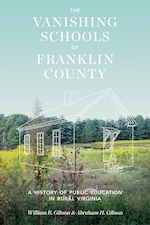
Today, we are happy to bring you our conversation with William B. Gibson and Abraham H. Gibson, authors of The Vanishing Schools of Franklin County: A History of Public Education in Rural Virginia
What inspired you to write this book?
As teachers, we have always been passionate about education, but we were stunned when we learned that our community was once home to more than 200 schools. After all, there are now only 12 schools in the entire county. We couldn’t help but wonder: what happened to the rest? We started looking in local archives and we quickly discovered that most of these old schools were abandoned long ago that most of them have long since disappeared. We resolved to identify as many of these old schools as possible and to determine how many of them are still standing. For years, we have combed through archives and trekked through woods looking for lost schools, and we have learned more about our community than we ever thought possible.
What did you learn and what are you hoping readers will learn from your book?
We learned that every little community had its own school as recently as a hundred years ago, and that most people did not stray far too from their home in the years before automobiles and paved roads. Life moved at a different pace, but people in the past were otherwise not so different from people today. They wanted the best for their children, but they were also products of their time, place, and culture. In some ways, one-room schools were idyllic. We can be proud that our forebears supported education, even when doing so was exceedingly difficult. And yet, in other ways, one-room schools were oppressive. Perhaps most importantly, segregated schools were not only inefficient but also immoral. We can valorize the past without fetishizing it. Consolidated public schools provide students with better instruction and more opportunities. They force students to be around different types of people and, in so doing, they not only cultivate empathy, but they also embolden democracy. These are universal lessons that transcend not only time and space but also race, class, gender, and station.
What surprised you the most in the process of writing your book?
We were consistently surprised by the graciousness of our neighbors while researching this book. These are divisive times, but the people of Franklin County have been uniformly supportive of our hunt for old schools. We have relied on the expertise and generosity of a great many friends and strangers, and each and every one of them has supported our project with enthusiastic zeal. This project has reaffirmed our belief that face-to-face social interactions are an essential part of historical research, public education, and pluralistic societies.
What’s your favorite anecdote from your book?
We have several favorite anecdotes. When astronauts walked on the moon in 1969, for example, most of the schools in Franklin County were still using outhouses rather than indoor toilets. Other anecdotes are instructive in different ways. Everybody knows that Booker T. Washington was born a slave in Franklin County in the 1850s, and that he would eventually become one of the most famous teachers in American history, but we were nevertheless surprised to learn the apocryphal story about young Booker eavesdropping on lessons at the local whites-only school because he wasn’t allowed inside the door. Other anecdotes are more whimsical. For example, we both loved reading about the various games that students have played at recess over the years. In many ways, the kids of yesteryear aren’t all that different from the kids of today.
What’s next?
Franklin County was superlative in many ways, and yet, in many other ways, it was very typical. Every community in Virginia has had to decide for themselves whether and how they were going to support public education, and these decisions are invariably fascinating. We are confident that others across Virginia can reproduce our methods to learn more about long-forgotten schools in their own communities. We are currently traveling to a variety of different libraries, universities, and historical societies scattered across Virginia, encouraging people to learn more about the history of long-forgotten schools in their communities, and explaining how they can get started.
You can learn more about our project at the following website:
If you’re up for a road trip, we have also curated an exhibit on the vanishing schools of Franklin County for the Blue Ridge Institute and Museum at Ferrum College. You can learn more at the following link: