Today, we are happy to bring you our conversation with Warren Eugene Milteer Jr., author of Freedom in the Age of Slavery: A History of Free People of Color in Virginia
What inspired you to write this book?
Long ago, I had decided to write a book about free people of color in Virginia. For years, I collected various records about free people of color in Virginia. I started researching records about free people of color as part of my interest in family history. As a descendant of free people of color from Virginia and North Carolina, I wanted to deepen my knowledge of my ancestors and the other families of free people of color associated with them. My family history interest eventually developed into an academic research focus. My first academic book was a study of free people of color in North Carolina. While I researched free people of color in North Carolina, I also studied materials about free people of color in Virginia. I knew that at some point I would want to publish a book about free people of color in Virginia using those materials. Several years after finishing my work on North Carolina, I’ve finally fulfilled my goal with the publication of Freedom in the Age of Slavery.
What did you learn and what are you hoping readers will learn from your book?
One major take away from my research on free people of color is the diversity that existed within this population. I come across individuals who have a stereotyped image in their minds about free people of color. The historical sources, however, show that free people of color were quite diverse in terms of their ancestry, appearances, positions in society, and community standing. Some free people of color had very close ties to slavery, having been emancipated in their lifetimes or were the children of such people, while other free people of color had quite distant familial connections to slavery and by default to Virginia’s large enslaved population. Many free people of color were closely related to white people and may have been raised by a white parent or other family member. This happened despite Virginia’s laws that focused on making unions between persons of color and white people illegitimate. Of course, some free people of color had ties to Virginia’s indigenous population, and at least some took those connections very seriously, openly identifying as persons of “Indian” descent.
What surprised you the most in the process of writing your book?
Some people may be aware that many counties in Virginia suffered significant records losses, especially during the Civil War and American Revolution. Those losses have left gaps in what we know about free people of color in certain parts of the state, including in areas that had large populations of free people of color. This problem is exacerbated by additional records losses in certain federal record groups, in particular early census records. During my research, I sought to provide as much coverage of the parts of Virginia that suffered records losses despite the events of generations ago. Through a careful study of old church records from those sections of the state, I was able to recover the names and activities of at least a few free people of color from those areas.
What’s your favorite anecdote from your book?
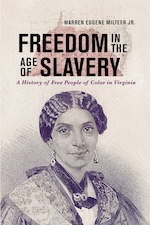
It’s hard to pick a favorite. Nevertheless, I would have to say that the life of Mary Smith Peake, the woman whose picture is featured on the cover of my book, is particularly interesting. Peake was originally from Norfolk. As a child, she was sent to Alexandria, which at the time was part of the District of Columbia, to attend school. Attending school was illegal for free people of color in Virginia at a certain point. In Alexandria, Peake took several years of coursework. Her academic studies, however, were cut short when Alexandria retroceded or returned to Virginia in 1846. Peake was forced to end her studies and return home. After returning to Norfolk and eventually moving to Hampton, Peake established an underground school to teach other people of color in her community to read. There is more to Peake’s story, including her tragic death, but you’ll need to read Freedom in the Age of Slavery to learn what happened next.
What’s next?
Next, I’m returning to capital punishment, a topic that has haunted the edges of my work for a long time.
I’ve started branching out my research beyond the South into other parts of the United States. I have another book that has just come out about free people of color during the Civil War era that looks at the experiences of free people of color in the North and South. I plan to continue building on this research and publish a broader study of free people of color in the United States.