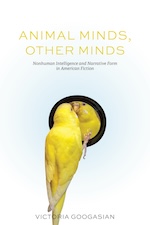
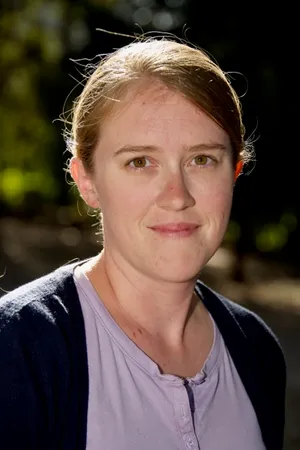
Today, we are happy to bring you our conversation with Victoria Googasian, author of Animal Minds, Other Minds: Nonhuman Intelligence and Narrative Form in American Fiction
What inspired you to write this book?
It always seemed obvious to me that fiction could help us imagine the lives and experiences of other species—and that this capacity made fiction a useful tool for living in a multispecies world. But I began working on this book when I realized that not everyone agreed on this point. Whether you’re a novelist or an animal biologist, speculating about the inner world of another species can provoke a backlash. That was true in one way or another for the past century. I wanted to understand the history and politics of those kinds of debates and the role they might play in literary history. At the same time, the more I looked into these debates, the more I realized that even the most ardent anti-mentalists often can’t keep themselves from engaging in speculation about the minds and experiences of other species. After decades of criticizing animal fiction for being overly anthropomorphic, the natural historian John Burroughs admitted in 1913 that “even a chipmunk shares a little of the wisdom that pervades the universe.” Our intersubjective relationships with other species are the key to seeing the universe otherwise, and I wanted to understand how fiction makes good on that realization.
What did you learn and what are you hoping readers will learn from your book?
I think writing this book helped me develop a new optimism about the capacities of imaginative fiction. The longer I worked on this project, the more convinced I became that fiction really can reflect a wide diversity of cognitive styles and kinds of minds. Fiction is proof that our minds aren’t sealed-off, interior spaces and we aren’t trapped inside them. I hope my readers will learn that modeling cognitive diversity is one of the things that fiction is good for—that’s one of the reasons why human beings keep trying to write about the mental lives of other animals even though our limited imaginations ensure that these accounts always fall short of the mark. Fiction might not be some kind of magical tool for “climbing into heads…to get the full story from the inside,” as Donna Haraway has warned us. But it can expand our sense of what might matter to others—humans and other species—what meaning-making practices these others might use, what concepts shape their apprehension of the world. That ability to decenter our own cognitive style can be useful not only for living with other species but also for living with other human beings.
What surprised you the most in the process of writing your book?
There were lots of little surprises and delights while I was researching this project, but one important surprise for me was that fiction and animal psychology really do have a shared history, and a weirdly fraught one. I knew before I started working on the book that American nature writers had struggled with the problem of animal minds around the turn of the twentieth century. But what I didn’t realize is that this struggle was actually a side-effect of the professionalization of animal psychology. In order to become an expert discipline, the science of animal mind had to reject imaginative projection as a method. It couldn’t be an armchair science. Founding figures in comparative psychology were fond of declaring that good stories were the enemy of good science, where animal life was concerned. That moment still feels very foreign to me, because in 2026 it seems like animal science has lots of good stories to tell about other species and inspires fiction writers with some frequency, as the coda to my book explores. But that early moment of conflict between science and storytelling cast a long shadow in both literary history and the history of behavioral science.
What’s your favorite anecdote from your book?
I actually chose to open the book with my favorite anecdote on the very first page—though I think there are lots of other interesting stories in the book as well! I had a great opportunity to spend time in the Octavia Butler Papers at the Huntington Library while I was researching this book, and one day I was going through a box of newspaper clippings that Butler had made from the Los Angeles Times and saved in her research files. One of the headlines, from 1994, completely poleaxed me: “Octavia the Octopus Dies as Tank Empties.” I was both charmed and a little disturbed by the idea of Octavia Butler saving this story. Basically, the octopus had deliberately removed the plug from her own tank, and her death intensified tensions between animal rights groups and the LA aquarium. But what really gave me pause was trying to imagine what Butler felt like when she read about this intelligent and also utterly alien creature who shared her name. She didn’t leave any specific notes that I could find, but she wrote a great deal about animal captivity in her journals and commonplace books, so we know that she had very complicated feelings about the things humans do in the name of other species. And for her, trying to imaginatively inhabit other minds was a basic part of authorship—maybe even an essential part of multispecies life. So I thought Octavia the octopus deserved a place in American literary history.
What’s next?
I have a new project that brings together different lines of interest that recently converged for me. I have been living and working in Qatar for the past several years, where pretty much every aspect of life has some connection to the energy industry. Because of that context, I have been able to participate in some really exciting collaborative research with colleagues here. We want this part of the world to become much more central to energy and environmental studies. At the same time, I have been pursuing a topic that appears only briefly in Animal Minds, Other Minds: play. Humans are only one of many species that engage in play behaviors, something that makes play promising as a mode of environmental relationality. But when I started looking into the intellectual history of play, I learned that play is also an energy concept—biologists have treated it as a metabolic function since at least the nineteenth century. Play, for these thinkers, was a way to reintegrate excess energy into useful biological functions. And this energy theory of play still informs how we think about what makes a good game or what makes an activity fun. I am working on a new book about the energy logic of games—provisionally titled Playing Energy. Since play has an energetic dimension and games often model energy systems, I want to treat games as themselves an energy infrastructure that shapes what kinds of collective futures we can imagine and realize.