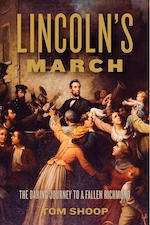

Today, we are happy to bring you our conversation with Tom Shoop, author of Lincoln’s March:The Daring Journey to a Fallen Richmond
What inspired you to write this book?
The inspiration for telling the story of Abraham Lincoln’s visit to Richmond in 1865 and examining its historical reverberations came in, of all places, Santa Fe, New Mexico. During a stay at a rental house there, I came across a copy of James Loewen’s Lies Across America: What Our Historic Sites Get Wrong, which included an entry on Lincoln’s visit to Richmond. In the book, Loewen noted that there was virtually no recognition in the city of this significant event, and made the case that Richmond should commemorate Lincoln’s trip with a series of historic markers.
I’d not heard the story of Lincoln’s visit before, and was intrigued by it—especially since my wife and I were planning to relocate to Richmond. So I began digging into the historical record of the event. As I conducted my research, it became clear that new information about Lincoln’s travel to and through the city had emerged in the years after Loewen’s book was published. Ironically, if the city had followed his recommendations, the result would have been a series of historically inaccurate monuments to the event.
What did you learn and what are you hoping readers will learn from your book?
First, I hope readers will learn more about this largely overlooked event in Lincoln’s life. It is a page-turner of a story, almost inconceivable in its details: The president of the United States, after making a harrowing trip up the James River—dodging mines and grounded ships, and ending up in a rowboat accompanied only by a small contingent of sailors—lands in a still-burning city which had been in enemy hands barely a day earlier. He then makes his way through throngs of admirers on foot, along with his son, who was celebrating his 12th birthday.
Beyond the details of the event itself, I hope readers will gain a broader understanding of how when it comes to Lincoln, the research environment is littered with untrustworthy and self-aggrandizing sources, dubious accounts, and outright fictionalized versions of events. Misinformation, especially of the kind that contributes to burnishing Lincoln’s image, can become so deeply embedded in the historical landscape that it is difficult to dislodge. In the case of Lincoln’s march through Richmond, that has resulted in a distorted and embellished picture that is, against all odds, actually less compelling than the true story.
Finally, I hope readers will gain an understanding of how despite Richmond’s best efforts to ignore the fact that Lincoln had visited, his link to the city—however brief and tenuous—has remained in place for generations, and had an impact on everything from the reaction to Reconstruction to the 21st century fight over removing Confederate monuments in the city.
What surprised you the most in the process of writing your book?
The fact that no one had written a book-length description and analysis of this event. Several works have explored the last weeks of the Civil War and of Lincoln’s life, but none have focused on the events of this one day, and how they have been remembered and forgotten. For many years after Lincoln’s death, his visit to Richmond was viewed as a highly significant moment, in some ways his crowning achievement. But it eventually became a footnote in his life story.
I also was surprised and intrigued by the way the story of Lincoln’s visit has been used to bolster the full range of historical arguments about his approach to leading the country through the Civil War. To Lincoln’s admirers, the Richmond trip is conclusive evidence of his humility and conciliatory attitude toward the soon-to-be defeated Confederacy. This was true not only of Union supporters in the North, but southerners who convinced themselves that Lincoln would’ve taken a more lenient approach to Reconstruction had he not been assassinated just days after the Richmond visit. On the other end of the spectrum, diehard Confederates and the neo-Confederates of the 21st century used the event in their effort to tarnish Lincoln’s reputation, arguing that he went to Richmond for the purpose of humiliating the South and reveling in its defeat.
What’s your favorite anecdote from your book?
The entire story of Lincoln’s voyage on the James River is incredible, but one part of it stands out to me. After Lincoln’s entourage had managed to work their way up the river reasonably close to Richmond, they came upon a spot where the Confederates had destroyed a bridge. Several Union vessels had run aground there—and, curiously, one Confederate ship. At its helm was none other than Admiral David Farragut, of “damn the torpedoes” fame for his rallying cry at the Battle of Mobile Bay. He had commandeered the ship in Richmond, and was joyriding downriver in the hopes of meeting up with the Lincoln party.
This must have come as quite a shock to Admiral David Porter, who was leading Lincoln’s voyage. Because in addition to the fact that they were two of only a handful of admirals in the Union Navy, Farragut and Porter were brothers. Porter’s father had adopted Farragut after his father suffered financial ruin and his mother died.
What’s next?
My next project is a labor of love, involving research into the history of military baseball in Virginia. Many major league stars played in military leagues in the state after having enlisted or being drafted into service during major conflicts. I hope to tell the story through the experience of my father, who played on service teams with some of baseball’s best players. In fact, he had the memorable—if not unique—experience of being thrown out on the base paths by the greatest player of all time, Willie Mays, during a game at Fort Eustis in Newport News on a summer night in 1953.