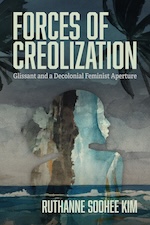
Today, we are happy to bring you our conversation with Ruthanne Soohee Kim, author of Forces of Creolization: Glissant and a Decolonial Feminist Aperture
What inspired you to write this book?
I was looking for a philosophical framework capacious enough to tangle with historical trauma, belonging and obligation without being limited to the Black and white binary of racism in the United States. Caribbean philosophy opened a door. It let the waves of social forces, varied and diverse, crash in. It offered tidalectical reasoning, allowing the to-and-fro of difference to bob side by side. It taught me to look not for what had been surmounted but for what was submerged. When I asked colleagues who could help me think about a whole world from one small place, they pointed me to Édouard Glissant and Martinique.
Glissant’s idea of creolization, a mixing that no one can predict or control, offered a way to hold the entanglements of living and teaching in red and blue states and in similar communities in Canada. In blue communities, I met people liberal in scope but narrow in confronting their own bias, still subscribing to structures of racial hierarchy. In red communities, neighbors who asked where I was “really from” also pulled our car out of ditches and watched my children so I could finish my dissertation. The truth was more tangled than either “racist” or “kind.”
As a Korean transnational and transracial adoptee, I know what it is to be transshipped, asked to assimilate and be grateful to a system that hides its neocolonialism, capitalism and war behind benevolence. I’m not Caribbean, and I wrote with care to learn from this tradition without taking it over.
What did you learn and what are you hoping readers will learn from your book?
I learned that opacity is a form of protection. Glissant argues that Western thought demands transparency, that everything and everyone be made legible, and that this demand is a way of controlling people. His response is the right to opacity: not everything needs to be visible to be respected. That idea reaches from the plantation overseer’s gaze to today’s surveillance, borders and databases.
I also learned to read water as philosophy. Glissant follows rivers from Martinique’s mountains to the sea, and the stagnant places, the swamps and the silt, where something fertile grows, subsists. When I heard politicians promise to “drain the swamp,” I heard it differently. I understood implicitly the dog whistle to eliminate places of hospitality against those deemed less than fully human.
And I learned that a book about one writer can be a conversation. Reading Glissant beside Luce Irigaray, Hortense Spillers, Saidiya Hartman, Sylvia Wynter and Françoise Vergès showed me gaps in Glissant’s work, and what they can say together. He wrote little about women, and the feminist readers add the depth and texture he theorizes.
What I hope readers take: Glissant is a philosopher for our moment of hurricanes, climate crisis and closed borders. He gives us a way to think about connection that doesn’t require sameness. And poetry and politics are not opposites. His poetry is political because it offers a horizon or transversal plane to extend what has been given and crisscross the currents of the now and agitate a new political reality.
What surprised you the most in the process of writing your book?
What surprised me the most was how readily I could find echoes of my story, and the stories of so many mixed race and mixed culture people, in the poetry and prose of Glissant. As the world continues to integrate, migrate, and meld, distinct and diverse cultures and species deserve our protection. At the same time, creolization, the process of being mixed and having something unexpected result, is a marvelous surprise that makes the world more diverse, a totality without that totality being one thing.
It is the age-old philosophical question of the one and the many. Glissant’s response is not a simplified or saccharine unity. It is an Antillean trail that allows small dots of difference to exist, flourish, and teach those whose continental lives, philosophies, and cultures are breaking apart, breaking down daily. It invites us not to be afraid of this increasingly diverse composition. Instead, join the street festival and celebrate the encounters happening in our economies, neighborhoods, homes, and intimate lives.
What’s your favorite anecdote from your book?
My favorite anecdote is about two statues in Martinique. In Fort-de-France, a statue of Joséphine, Napoleon’s first wife, who was born into a Martinican sugar family, stood in La Savane park. Many on the island suspect she influenced Napoleon’s reinstatement of slavery in 1802. In 1991, protesters beheaded the statue and splattered it with red paint for the blood that decision cost. In 2020, activists tore it down and spray-painted “death to colonialism” on the pedestal.
Across the island, in Rivière-Pilote, stands a statue of Lumina “Surprise” Sophie, a seamstress who in 1870 helped burn plantations in the Southern Insurrection. She holds a torch. The court called her “the flame of the revolt.” She is quoted as saying, “I want to burn everything, and if the good Lord descended from heaven, I would burn him too, because he must be an old béké!”
One woman’s influence is remembered with a beheading, the other’s with a torch. I value that pairing because it shows how memory is a political fight, and how a history Glissant helped us question is still being rewritten in public places.
What’s next?
I want to share the book in ways that demonstrate creolization as method, so I have invited different groups of people to present with me what the force of creolization looks, sounds, smells, tastes, and feels like. I am inviting justice-impacted students I have taught on the inside and outside to show how the waves of creolization reverberate with those who persist and defy the odds of recidivism. I will feature the voices of ordinary parents who wrote social media posts sharing the realities of Operation Metro Surge in Minnesota in the winter of 2026, and why immigration is so intimately tied to the legacies of biopolitical control that Glissant critiques in his analysis of economic alienation in Martinique. I will center the voices of 2SLGBTQ+ artists and activists I work with to advance antiracism work in Central Minnesota, and why annual fêtes like Carnival remain precious sites of social and political resistance to sexual and gendered norms. I have applied to present at the Caribbean Studies Association’s annual meeting in Miami this June, and I will be at the Caribbean Philosophical Association’s annual meeting in Birmingham, UK, this summer. I am also continuing my work in Critical Adoption Studies and proposed a paper on mixed race identity, particularly the construct of “Whasian,” to the Association for Asian American Studies. I’m looking forward to what comes next, with new projects and new places to share this work.