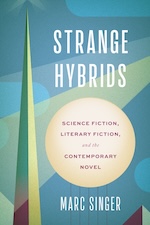

Today, we are happy to bring you our conversation with Marc Singer, author of Strange Hybrids: Science Fiction, Literary Fiction, and the Contemporary Novel
What inspired you to write this book?
As an English professor, I used to hem and haw whenever somebody asked me what my favorite book was—there were just too many good candidates. I haven’t had that problem since I read Francis Spufford’s Red Plenty, a brilliant, almost uncategorizable work that combines the vivid characters and rich language of historical fiction with a carefully documented economic analysis of the Soviet Union during the Khrushchev era.
The strangest thing about Red Plenty is that I was under the misapprehension that it was a work of speculative fiction, an alternate history of the Soviet utopia that never was. It’s not—it’s actually an account of why that planned utopia never came to be—but trying to figure out why so many readers have approached it that way led me to explore current trends in contemporary literary fiction that draws on the conventions of science fiction, and vice versa. The result was Strange Hybrids, a book about the overlap between two previously incompatible genres that now appear to be converging on each other as modern life grows more science fictional with each passing day.
What did you learn and what are you hoping readers will learn from your book?
I wasn’t expecting so many of these genre hybrids to address the importance of the humanities in the twenty-first century, but I suppose I should have. Even before the development of AI, the arts and humanities were in danger of being marginalized as politicians and universities promoted STEM fields to the exclusion of other kinds of knowledge. Novelists have responded by using the sciences to talk about the role of literature in fostering our understanding our world.
We see this in books like Richard Powers’s The Overstory, a novel that many critics have read as depicting a pessimistic or “doomerist” vision of climate change but which I see as exploring how we can use narratives to develop stronger connections with other people or even other species as a means of ensuring our survival. Or take Jennifer Egan’s The Candy House, which engages with the quantification metrics that drive social media and anticipates the rise of algorithmically generated content, but ultimately makes the case that fiction is still our most effective tool for imagining other lives and empathizing with other people’s experiences.
I hope readers will see that these genres, science fiction and literary fiction, are not hard and fast boundaries but versatile instruments that novelists have used to address every facet of the contemporary world, including the importance of the humanities in considering humanity’s future.
What surprised you the most in the process of writing your book?
This whole project was a process of discovery. Initially, I just wanted to find more novels like Red Plenty. I didn’t, but the search led me to all sorts of strange new novels doing similar work in radically different ways, whether it was the surreal historical allegories of Colson Whitehead’s The Underground Railroad or the rigorously realistic “space pastoral” of Samantha Harvey’s Orbital. I spent a couple years looking at old favorites in a new light and discovering new works I might not otherwise have read. This book was a pleasure to write, as I hope it will be to read.
What’s your favorite anecdote from your book?
Do I have anecdotes? My method is sitting down at my desk and writing about other people’s words, which doesn’t really lend itself to colorful anecdotes—the best stories in my book all come from the novels I study.
That being said, there was a moment of pure joy when I discovered that The Candy House contains an absolutely perfect, mechanically accurate description of Dungeons & Dragons, a game that I have played since I was a kid and now share with my son. Egan gets every detail right, and in her hands the game becomes a surprising fit for her exploration of systems that model and quantify human interaction, but without the elements of surveillance and control that shadow so many of our online activities. It was an unexpected delight to watch a favorite author find new meaning in something that has been such a big part of my life. That was actually the moment when Strange Hybrids came together, when I knew I’d found the final piece I needed to complete the book.
What’s next?
I guess my interests are bifurcating again since I’m in the early stages of two projects, one about literary studies and one about science fiction.
The latter would be a book about The Legion of Super-Heroes, a long-running comic book series that has tried and failed to envision our future for nearly seventy years, often faltering on the inherent contradictions of its medium. The former is a more inchoate but possibly more urgent project about how literary studies and the humanities in general approach politics primarily as a field of representation rather than a network of systems, coalitions, and institutions, and the costs of doing so. We’ll see which gets written first.