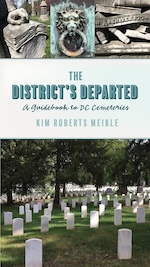
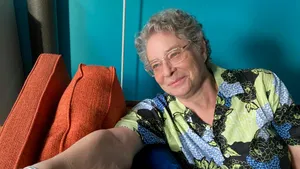
Today, we are happy to bring you our conversation with Kim Roberts Meikle, author of The District’s Departed: A Guidebook to DC Cemeteries
What inspired you to write this book?
As I’ve worked on this book, I’ve been delighted to learn how many people I talk to share my deep fascination with cemeteries. I’ve loved cemeteries since I was a child, loved walking historic burial grounds, reading the names and the strange little verses engraved on stones. As I wrote in the introduction, “There were stories implied in all the old stones—half-glimpsed lives of women who died in childbirth or from smallpox, the sailors lost at sea and the farmers whose last names remained local landmarks, repeated as the names of the town’s roads. I loved the claims of high morals, the firm hopes of future redemption.” When traveling, I often seek out cemeteries. I’ve become a tombstone tourist! Among my favorites outside of my hometown of DC are Pere Lachaise in Paris, and the royal tombs in Gaitor Ki Chhatriyan in Jaipur.
What did you learn and what are you hoping readers will learn from your book?
Washington, DC has cemeteries that rival some of the best in the world! Everyone knows about Arlington National Cemetery, of course. But we have other gems. The funerary statues in Rock Creek Cemetery are some of the best in the nation. Oak Hill Cemetery plunges into the Rock Creek gorge, creating stunning vistas. And Congressional Cemetery models some of the best community outreach I’ve ever seen in a graveyard. When you look at how the our ideas of the best ways to commemorate our loved ones have changed over time, it becomes immediately apparent that DC’s major contribution to cemetery design is in military cemeteries. Developed first during the Civil War, American military cemeteries have now spread around the world—but they still follow basic design principles that Brevet Major General Montgomery C. Meigs, the Quartermaster General of the US Army during the Civil War, set out first in DC.
What surprised you the most in the process of writing your book?
There are a surprisingly large number of cemeteries in the city that were moved. In 1852, a DC ordinance required that all existing cemeteries located within the original city boundaries, south of Florida Avenue, exhume all of their bodies and relocate to new sites further out. Thus we have National Harmony Memorial Park in Landover, twice relocated from earlier locations in Washington City (in 1857 and 1950), and the entire exhumation of Graceland Cemetery into Historic Woodlawn Cemetery in 1895. The closure of cemeteries within the DC corporate limits was handled poorly, and in general the segregated cemeteries for people of color were closed with an incredible lack of sensitivity, which resulted in massive problems identifying disinterred bodies, bodies separated from their historic grave markers, and—perhaps most alarming—incomplete removals that left large numbers of bodies unclaimed and without the proper respectful and dignified disposition of reburial. It was a real mess. As modern construction has continued over the sites of previous cemeteries, we continue to discover remains. This has happened in several locations: the Stanton Glenn Apartments (formerly Rosemont Cemetery), Fletcher-Johnson Middle School (formerly Payne’s Cemetery), Walter Pierce Community Park (formerly the Colored Union Benevolent Association Cemetery), Suitland Parkway (built over Hillsdale Cemetery), and Rhode Island-Brentwood Metro Station (formerly Columbian Harmony Cemetery).
What’s your favorite anecdote from your book?
My favorite site belongs to Henry Adams and his wife, Marion Hooper Adams, known to her friends as Clover. Their names do not appear on their unusual grave site at Rock Creek Cemetery. Built as an outdoor hexagonal room, surrounded by tall bushes that enclose a bench and a statue of a mysterious figure, this is arguably one the most important pieces of figurative art in the US. Knicknamed “Grief,” the figure isn’t quite male or female, and it isn’t quite Eastern or Western in influence (although it was modeled after the Japanese god of compassion, Guanyin). After Clover’s suicide, Henry Adams (a historian best remembered as the grandson and great-grandson of two US presidents), realized that traditional commemorative traditions would not be appropriate. He commissioned Augustus Saint-Gaudens, the foremost American sculptor of the second half of the 19th century, to create the memorial. The result was something unprecedented for a gravesite—something beautiful to counterbalance the shame and scandal of Clover’s violent death. I am touched by its otherworldly presence every time I visit (which is often, since Rock Creek is the closest cemetery to my house). I’m not the only one who finds the site soothing: Eleanor Roosevelt visited regularly when she was the First Lady, and the monument has appeared in literature again and again. I’ve been collecting poems that seek to interpret the sculpture’s meaning, and have found fourteen so far. (I’ve also jumped into the pool and written a poem of my own about it.)
What’s next?
I am in the process of editing a new anthology of poems, following the success of my earlier book, By Broad Potomac’s Shore: Great Poems from the Early Days of Our Nation’s Capital (released by the University of Virginia Press in 2020). This new anthology will survey the history of LGBTQ+ poets in DC from the city’s founding in 1800 to the present. Some of the poets will be well known, such as Langston Hughes and Walt Whitman. Some will be surprises to most readers, either because their connection to the national capital is not widely known, they are better known for other achievements, or because their identity as queer writers has not been widely accepted. (The oldest authors in the book lived in a time when there was no vocabulary yet to describe queer identity, which also sometimes complicates arguments for their inclusion.) Featured poets will include: Benjamin Banneker, Clara Barton, Louisa May Alcott, Rose Elizabeth Cleveland (a former First Lady), Zora Neale Hurston, and Pauli Murray. Among the modern and contemporary poets, there are so many that I will have to make some difficult editorial decisions. Clearly, America’s capital is queerer and more radical than we are used to thinking. And I think that tension will make for a very exciting collection.