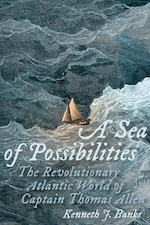
Today, we are happy to bring you our conversation with Kenneth J. Banks, author of A Sea of Possibilities: The Revolutionary Atlantic World of Captain Thomas Allen
What inspired you to write this book?
That’s a really tough question!
Growing up within an hour of a busy border crossing in British Columbia had much to do with it. Everyone I knew smuggled in a small way all the time. Most folks felt the laws were silly and annoying. I also sailed when younger, and had long felt that the maritime dimensions of Early Modern history were slighted. I suppose I had grown up with a desire to understand seaborne smuggling.
My first book, Chasing Empire, had revealed a world of clandestine, inter-imperial trade. I thought contraband would make a riveting second project. When I first arrived at the American Antiquarian Society, then Manuscripts curator Tom Knowles suggested that an obscure collection, the Allen Family Papers, were a good place to start. But the collection consisted of literally thousands of documents. I didn’t really know how to piece them together.
As I struggled writing and rewriting Allen’s story, I heard Eddie Glaude Jr. speak at Wofford College about “the lie.” For Glaude, this means a set of stories that white Americans tell themselves to justify the historical maltreatment of people of color. Glaude helped me see that Allen’s life also invited a confrontation with another (and closely related), set of stories: the unquestioned nobility, presumed unity, and inherent justness of the Revolution’s “Glorious Cause.”
What did you learn and what are you hoping readers will learn from your book?
Three things.
The struggle to build a life of achievement and comfort, and then hold on to it through the catastrophe of war, is not a story we often associate with the Revolution. Even as they gained a Republic, people like Allen lost a lot.
I also hope readers understand how and why the sea had deep yet diverse meanings for different peoples of the time. I suppose there’s a Rachel Carson [The Sea Around Us, 1951] imperative at work. The sea was not just background, or something dangerous to be crossed as quickly as possible. Instead, people of the era were immersed in it, physically and mentally, and influenced by the sea in myriad ways we have largely forgotten. The closest parallel for contemporary American life might be the obsession with cars, trucks, and the meanings of ‘The Open Road.’
Most of all, I feel it crucial that people, both in America and beyond, must advance beyond the fairy-tale past of the Revolutionary era. It’s acceptable for children to believe in fairy tales – they can be entertaining and instructive. But when adults turn fairy tales into national history, they are shackled to a make believe world. It distorts justice, erases inequality and pain, and debases fundamental human values. It becomes a caricature of what the struggle entailed, and stunts the ability to make hard, mature choices.
What surprised you the most in the process of writing your book?
I am embarrassed by how naïve I was when first analyzing the documents. I had assumed, like most readers and I think even some scholars, that the major minds and events of the time often dominated everyday people’s lives.
Instead, it soon became clear that Allen and his many friends paid little to no attention to the major Revolutionary events of the time. The first moment Allen mentioned a major incident in all of his correspondence occurred late, when the British closed Boston’s port in 1774. That caught his attention. It reminded me of when I first read Laurel Thatcher Ulrich’s The Midwife’s Tale [1991] and wondered, “But wait - where’s the Constitutional Convention?” It’s easy to imagine that people’s lives are guided by, or in reaction to, major political events. Allen’s story is a corrective to that assumption.
The cosmopolitanism of Allen’s World is fascinating. I had immigrated to Canada when young, and gravitated to those who were also initially outsiders – ‘New Canadians,’ as we were called then. The more I read the documents of Allen’s world, the more it sounded strangely familiar. Sea captains and their families, and mariner folk generally, lived and dealt with a far greater range of peoples from a kaleidoscope of places and cultures than we tend to imagine today.
Finally, I remain surprised at how much long-term debt dictated nearly everything Allen touched. Not too different for many today, I’m afraid.
What’s your favorite anecdote from your book?
Not sure this is my favorite, but it’s certainly one of the saddest. [Spoiler alert!]
Allen’s older half-brother, Jolley Allen, was a Loyalist. He made a daring escape from the Patriots in the early going of the fighting, finding refuge on a British warship. But he left behind four surviving children in the care of Allen and a younger brother.
While living as an American Refugee in London, Jolley kept a journal and copies of his letters. He wrote many to his four surviving children, expressing his love for them, anguish at leaving them behind, and assuring them repeatedly that he had plans for them to be re-united.
One particular was quite lively. When he learned that his eldest daughter, Eleanor, had become engaged, he wanted to know all about her future husband, whether he would be able to support her, and so on - fatherly concerns of the time. But war greatly slowed the passage of letters from England.
Allen received the letters at least six months to a year later. It turns out that Eleanor never read her father’s letters, and that she never wed. Instead, Allen had to inform his brother that she had died of what we now call tuberculosis. The clash of hope and death still chokes me up when I feel the irony of the passage. That’s the part of Revolutionary conflict we don’t often wish to acknowledge – war is hardship, inlaid with personal tragedy, and painted with bitter irony.
What’s next?
I’m busy with two articles rooted in research on the book. The first is an article on the ‘holistic’ nature of privateering. The other is an overview of the major maritime environments of the American seaboard and their centrality to trade, food, and demographics in the decade leading up to the Revolution.
But I’m most excited by the work conducted by sociologists in what has become known as ‘Mobility Studies.’ These evolving sets of studies grapples with the political and social justice dimensions of the control and implementation of people’s movement – migration, access to transportation, border control, conceptual links between freedom and movement, and so on. At this point, I’m not aware of any historians who have fully engaged with or applied the exciting theoretical work of these scholars – which is vast - to historical questions.
My focus will be on Anglo-French competition over control of the Atlantic Ocean over the course of the eighteenth century. At this point, I see this competition as a part of Enlightenment influence on maritime affairs, or what I call in the book the “Deep Blue Enlightenment.” My guess right now is that this aquatic Enlightenment guided much of the course of the Enlightenment as whole. I conducted initial research at the John Carter Brown Library two years ago. We shall see where it leads!