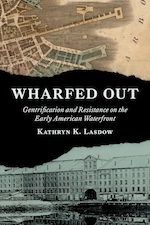

Today, we are happy to bring you our conversation with Kathryn K. Lasdow, author of Wharfed Out: Gentrification and Resistance on the Early American Waterfront
What inspired you to write this book?
I’ve always been fascinated by the architectural history around us, and why cities and towns look the way they do, and how they came to be. As a child, my parents and I would take long drives through Massachusetts’ small towns looking at historic homes and we’d spend hours walking around downtown Boston. I was very lucky to be surrounded by important examples of early American architecture from a young age, and then I went on to study it through degrees in History and Architectural History. Now when I walk around Boston, I’m constantly looking up and down at the buildings around me, exploring the nooks and crannies of urban spaces. My students used to joke that walking around the city with me ruined them for tuning out their surroundings, because once you know how to spot brick bonds, stylistic details, and the telltale signs of a historical building period, you can’t NOT see them everywhere. I wanted to write a book that let me keep exploring those nooks and crannies while also repopulating them with the stories of the men and women who encountered these built landscapes in their own lives. Cities are fascinating artifacts of human creation.
What did you learn and what are you hoping readers will learn from your book?
I hope readers come away understanding that many of the forces we label in urban development today — the things we now describe with the term “gentrification” — have roots stretching back centuries. The decades immediately following the American Revolution are one period in which we can study those roots up close, through the material culture and documented experiences of the men and women who encountered urban change in their own lives. I also hope readers come away understanding that just because resistance to urban growth and change was more often than not unsuccessful, that doesn’t mean it didn’t matter, or that it had no effect on the way a project took shape or how people encountered a space once it was completed. Ordinary residents of America’s cities might not have always supported large-scale development, but they found creative ways to resist projects underway and to live with these spaces once they were finished.
What surprised you the most in the process of writing your book?
I was most surprised by how much the project evolved throughout the process of researching and writing. I first came to it curious about how Americans in the early national period turned to neoclassical architecture as a tool for showcasing a new political, social, and aesthetic identity. I found it fascinating that they used that architectural language of the classical orders for buildings as lofty as a statehouse and as lowly as a warehouse. Architectural design is not random, but rather it’s an expression of the tastes and priorities of the people building it. I was also interested in how people encountered these buildings in their daily lives, and how those encounters shifted depending on whether you were white or Black, free or enslaved, male or female. But the arc of the book itself, the story of gentrification and resistance at its core, emerged only after spending over a decade with this source material. There were many roads the sources pointed down, so it was an ongoing journey to determine how to tell the story of urban development, land creation, and gentrification in early American cities.
What’s your favorite anecdote from your book?
Many of the locations explored exist not in extant buildings but in archaeological fragments and foundations beneath our city streets. Once you know how to read a landscape for evidence of change over time, you can begin to see our cities in an entirely new light. In Alexandria, Virginia, for example, archaeologists have uncovered both timber landfilling cribs and scuttled ships, used as physical containers for wharfing out the shoreline. We know about the scope and scale of urban development in early Alexandria because of these artifacts. The physical record has much to reveal about people’s relationship to their cities in early America.
What’s next?
I recently underwent a major career change, leaving a university professorship for a position as Director of Engagement at the Massachusetts Historical Society. In many ways, I feel like I’m returning to my roots in public history, and I’m excited to spend the bulk of my time building programs and partnerships that help bring the history of Massachusetts to a wider community. I feel incredibly fortunate to do this work at one of the nation’s foremost research archives. I’m surrounded by the history I love every day!