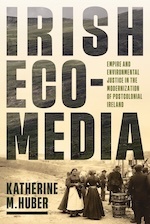


Today, we are happy to bring you our conversation with Katherine M. Huber, author of Irish Ecomedia: Empire and Environmental Justice in the Modernization of Postcolonial Ireland
What inspired you to write this book?
This book comes from persistent questions I have had about power and land for decades. Right after high school, I started working in experiential education on tall ships, which in my case were large, wooden, gaff-rigged schooners. Through the places I visited and the people I met, particularly in the Caribbean, I started having questions that I didn’t have the vocabulary or knowledge to answer. That’s when I decided to go to college. I ended up earning my BA and MA at Leiden University in the Netherlands. Through my studies, I learned about entangled environmental and colonial histories across Dutch and British empires.
When I first became interested in questions about land and power, I hadn’t thought of studying Ireland. But as I was regularly traveling to Ireland while working in communications after graduation, it soon became apparent to me that Ireland’s history and cultural regeneration both fit and challenged postcolonial and ecocritical theories and thinking.
The Republic of Ireland is unique in its position as a postcolonial nation and European Union member state. In many ways, its position in Europe has led Ireland to be overlooked in postcolonial ecocritical studies. Yet Ireland’s long history as a British colony and colonial testing ground have shaped the material environments in Ireland and human and more-than-human relationships to those environments in unexpected and lasting ways. My book grapples with the complex ways Ireland emulates and resists colonial forms of development.
What did you learn and what are you hoping readers will learn from your book?
I learned that decolonization needs to happen everywhere if it’s to happen anywhere. This sounds abstract, but connections between the environment and colonialism in Europe remain understudied even as these connections inform everyday interactions. Ireland is often overlooked in postcolonial ecocritical scholarship because of its position in Europe. Even when postcolonial states like the Republic of Ireland try to decolonize, the legacy of colonialism in material relationships with the environment constrain what is possible or even imaginable.
As I was researching Irish Ecomedia in various archives, I saw how frameworks that scholars often use to investigate and critique formations of power in many colonial and postcolonial contexts do not cleanly apply to Ireland. This means that understandings of difference generated in studies of other contexts, such as in the US or Global South, may obscure difference and power in Irish contexts. I wanted to expand and nuance understandings of how environments, media, and power continually interact in this postcolonial country in Europe.
Irish Ecomedia shows how those negatively impacted by social and colonial hierarchies creatively drew on a range of media and narrative resources to articulate their struggle and sustain their communities and cultures. This challenged me to rethink how positions of privilege and intersectional oppressions emerge and shift over time and can be concealed in unexpected ways. I hope the book similarly challenges readers to expand scholarly approaches to and ignite interest in decolonization in Ireland and in Europe.
What surprised you the most in the process of writing your book?
It was surprisingly hard and emotional to let go of this project. I always thought that I would publish my research, but I am a perfectionist, as so many academics are. Recently, I was listening to a podcast about perfectionism and learned that Margaret Atwood has published almost a book a year for decades. When asked how she did that, she responded that she’s not a perfectionist.
This really resonated with me as I was in the final stages of the publication process. I was editing things up to the very last minute—and beyond! I’m grateful to Andy Edwards at the University of Virginia Press for his patience with me at this stage. I still wake up wondering if I worded everything in the best way for readability and accuracy. Since I’m trying to reach a broad range of scholars in the environmental humanities, many of whom may be less familiar with Irish history, I had to strike a fine balance between specificity and accessibility.
I was also surprised by how much the project changed over the years. It’s reinforced for me how writing remains a practice of lifelong learning. When I was in graduate school, I struggled to make my ideas clear and understandable to my dissertation committee members. I’m glad my committee kept working with me and that I persevered. Through their guidance and the processes of archival research and writing, I could develop the skills to articulate my ideas into what Irish Ecomedia has become.
What’s your favorite anecdote from your book?
I came to really love the third chapter about the work of Seán Ó Riada. Examining music and its possibilities for imagining alternative forms of development was special to me because of my love of music. The research process for this chapter was also full of surprises. It began in conversations with Aileen Dillane, an ethnomusicologist at the University of Limerick, whose work and mentorship shaped my initial approach. My subsequent archival research was truly a process of discovery. At the University College Cork Library, I remember being absolutely delighted in the archives by a series of letters from Brian Friel to Ó Riada in the late 1960s. They describe a project Ó Riada and Friel were thinking of doing together, but it never happened.
The correspondence of these now famous artists thinks through ideas I was also grappling with. This helped me to make sense of how Ó Riada’s 1962 radio program Our Musical Heritage innovates oral traditions through broadcast technologies and the natural systems upon which they rely. The content and medium of the program invoke the rotation of the Earth and radio’s interactions with planetary electromagnetic fields. As Friel was writing to Ó Riada in the late ‘60s, the circular and environmentally grounded elements in Ó Riada’s music and the way Friel described their potential collaborations brought seemingly disparate ideas into unexpectedly closer connections.
While researching all the chapters brought surprises, this chapter changed how I think about media and environment in cultural expression and regeneration.
What’s next?
Having migrated back and forth between the US and the Netherlands while writing a book about Ireland, I’ve become interested in how interlocked and interrelated migration and environment are. We often treat them as separate issues, but migration–both human and more-than-human—changes how we view different places and the relationships between them.
The development projects I examine in Irish Ecomedia drew people, plants, animals, and geologic materials from across the British empire to imperial metropoles. Similar relationships of migration and environment remain across histories of colonialism and development in the Dutch Kingdom, which includes the European Netherlands and six islands in the Caribbean. Next, I plan to comparatively examine diasporic representations of terrestrial and aqueous environments across Irish, British, and Dutch contexts since WWII. By doing a comparative project, I hope to reframe methodological emphases on national contexts and rethink what it means to belong on a changing and migratory planet.
I’ve also started thinking more about how arts-based research can push the boundaries of scholarship. This comes from my collaborations with artist and writer Michele Horrigan to host a version of her Stigma Damages exhibit at Tilburg University. Horrigan’s work engages with the environmental injustices of the Aughinish Alumina bauxite refinery in west Limerick.
I’m very excited about new projects, but I also need some time to reflect as I let go of Irish Ecomedia. I hope to do a lot of reading in the coming year to let my ideas settle and see what new possibilities emerge.