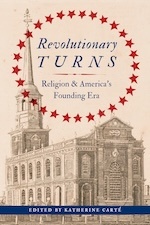
Today, we are happy to bring you our conversation with Katherine Carté, editor of Revolutionary Turns: Religion and America’s Founding Era
What inspired you to write this book?
The origins of this book lie with the Son’s of the American Revolution. For years they have sponsored an annual conference presenting new research in the field, and I was honored that they asked me to spearhead one on religion and the American Revolution. At the time, I was deep in a project that looked the topic from a bird’s eye view of the whole British Empire. But I knew there was lots of great work being done from many different angles. It was a privilege to bring some of those people together through the support of the SAR.
The book that we’ve produced looks at religion and the nation’s origins in exciting new ways. That topic is referenced a lot in political discussions, because Americans are very invested in the idea that the United States was “founded on the separation of church and state” or that Americans fought for religious freedom when they fought the Revolutionary War. But those political statements do not have that much to do with how people in the founding era experienced religion. It’s an important topic that deserves full historical investigation.
What did you learn and what are you hoping readers will learn from your book?
When we think of religion and the Revolution, we’re often thinking of pretty specific questions – like whether religion motivated Americans to fight against the British. But religion was (and remains) a huge part of life, so it intersected with the transitions of the Revolutionary era in countless ways. Each essay in this book has its own perspective. For example, Michael Baysa argues that the lack of printing apparatus during the war shaped how different theological arguments survived and thrived during the era. Jessica Nelson looks at how Indigenous Americans turned to faith communities to create survival strategies during the war’s upheavals. Adam Jortner takes readers through some of the challenges American Jews faced. When they read this book, I hope readers will come away with a sense of just how many ways people’s religious lives were touched and transformed by the Revolution.
What surprised you the most in the process of writing your book?
When you put together a conference or a set of essays, you’re asking people to write about what’s interesting to them at the time. There’s always the risk that the papers will not have much to do with each other. But that was not the case with this conference and volume. It was clear very quickly that all the authors shared some of the same basic approaches to the question. I think that says a lot about how this era of writers views the Revolution. First, we all agreed that the Revolution had primarily secular causes, even though it had huge consequences for American religious history. Second, a lot of us were very interested in the later 1770s and 1780s, the rough middle years of the Revolutionary process. This focus made a lot of sense after we talked about it, however. We tend to celebrate the American Revolution as a period of “founding,” especially in this anniversary year. But founding something is difficult and often requires a lot of struggle. Those “Revolutionary Turns” had big impacts on American religion.
What’s your favorite anecdote from your book?
When our conference was winding down, the lead scholar from the SAR, Joe Dooley, commented that it hadn’t been at all what he expected, but that it was all really interesting, nonetheless. That was my favorite moment connected to this book, and I think it will probably be true for a lot of readers. The ideas that we bring to the subject don’t often connect directly to the experiences of the people at the time. But the stories that historians have uncovered here are fascinating. If you want my favorite piece of evidence from the book? Hands down, that’s Seth Perry’s proof that Lorenzo Dow plagiarized Thomas Paine.
What’s next?
I’m still working on the American Revolution, but after focusing on some really large-scale issues, I’m looking at a very specific time and place. In 1773 the Selina Hastings, the Countess of Huntingdon, sent a group of missionaries to Savannah, Georgia. They were based on a rice plantation, where the countess enslaved about one hundred people. I’m following the history of the women at this place over the next twenty years. Stay tuned!