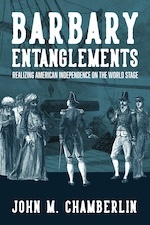


Today, we are happy to bring you our conversation with John “Garick” Chamberlin, author of Barbary Entanglements: Realizing American Independence on the World Stage
What inspired you to write this book?
It first got started as an effort to blend my Arabic language and Middle East history backgrounds with the US military history that is a key part of the curriculum at Air Command and Staff College. The Barbary Wars piqued my interest as the first US military interaction with the Middle East. Once I began digging into the primary documents, I quickly realized that not only was this era too often overlooked, but also that the story was much more complex and interesting than usually presented, when presented at all. It quickly became obvious to me that this wasn’t just military history, it was also diplomatic, legal, economic, and much more. And the characters involved were fascinating. I particularly grew to like the bluff pragmatic sailor Richard O’Brien, who went from fighting in the Revolutionary War to merchant captain and then from Algerian captive to US Consul to Algiers, but never lost the habit of speaking in nautical allusions. The more I learned about this story and how interconnected it was with many other issues in the early American republic and the broader Mediterranean and Atlantic worlds, the more I wanted to share it.
What did you learn and what are you hoping readers will learn from your book?
I learned so much that I can’t hope to cover it all in response to this question, from how much issues of petty jealousy created friction in the early American military or how privateering and corsairing worked to the complex connections between diverse domestic and international issues. The most impactful realization, though, was just how important international law was to American politicians and diplomats, and how much they expected American respect for it to convince European powers that America belonged in the “real nations club.” I was already aware when I started that the “Barbary pirates” weren’t actually pirates from a legal perspective, but I was surprised by just how deeply they were connected to European notions of international law. I hope that my readers take away not just a better understanding of early American foreign policy, but also the law-bound nature of corsairing, and how dealing with it appropriately helped America join the club.
What surprised you the most in the process of writing your book?
As I mentioned above, I was surprised by how deeply North African corsairing was connected to European notions of international law. I was aware that corsairs had licenses from their respective governments, but I didn’t realize how legitimate European nations considered them. I was shocked to see that Europeans not only recognized North African corsairs’ right to stop and search merchant vessels, but also that North African privateers would occasionally take ships captured as prizes to European admiralty courts for adjudication. I learned about this early in my research project, when one of the American ships captured by Algiers in 1793 was taken into Cadiz, where the court ordered it a good prize and the Algerians sold it to a local buyer. Shortly thereafter I found examples of European privateers taking their prizes to North Africa for adjudication. Donald Petrie called privateering “the Prize Game,” and Europeans not only accepted Barbary as players in that game, but even as legitimate umpires.
What’s your favorite anecdote from your book?
How, as I put it in the introduction to Chapter 3, "in August 1796, Captain Richard O’Brien was captured by Barbary corsairs. Again." O'Brien had spent over a decade in Algerian captivity by that point, but American diplomats had finally negotiated a peace treaty and agreed to ransom the prisoners at a cost (between ransoms and peace indemnity) of $624, 500. But the diplomats didn't have cash, just a letter of credit. So O'Brien was paroled and embarked on an epic journey to raise the cash. He sailed from banking center to banking center, but due to war in Europe, hard cash was hard to come by. Eventually, he sailed back to Algiers with $200,000 to make a partial payment, and was captured by Tripolitan corsairs on the way. While he had all the required papers, they took him back to Tripoli anyway, either suspecting forgery or just unwilling to give up such a rich prize without at least trying to convince a court it was legitimate. After investigating his papers and some preliminary peace discussions, Bey Yusef Karamanli of Tripoli released O’Brien to return to Algiers.
What’s next?
I am working on a biography of William Eaton, one of the characters in this book. In terms of Barbary issues, he was US Consul to Tunis from 1799-1803, and later leader of the 1805 Derne Expedition that gave the US Marines the line "to the shores of Tripoli" in their hymn, but that is only a small part of his story. Eaton was involved in many of the early republic's key moments. He was an enlisted soldier in the Revolutionary War and later an officer in the new "Legion of the United States" in the 1790s. He served in Northwest Indian War and commanded a fort on the border with Spanish Florida. Before becoming Consul to Tunis, he was both court-martialed and helped foil the Blount Conspiracy, a plot to have Great Britain take over Spanish Florida and Louisiana. After his famed Barbary exploits, he was a key witness for the prosecution in the treason trial of Aaron Burr. As well as these connections, he also had an interesting personality and family life and a complex relationship with issues of class and slavery. Unlike Richard O'Brien, I don't have much fondness for Eaton, but I do find him fascinating, and he offers the chance to discuss a wide range of social and political issues. I look forward to telling his story and how it connects to that of the early American republic.