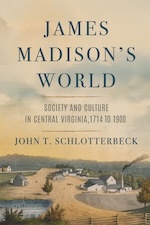

Today, we are happy to bring you our conversation with John T. Schlotterbeck, author of James Madison’s World: Society and Culture in Central Virginia, 1714 to 1900
What inspired you to write this book?
The book has both personal and professional origins. My family moved to Lynchburg when I was nine years old and even as a privileged white child race was ever present—segregation and Lost Cause culture were still alive—both in personal interactions and social institutions. Living within a white veil, I was largely ignorant of Black life and culture. Determined to leave Virginia behind I went to The Johns Hopkins University and enrolled in Hugh Davis Graham’s course on the Modern South my junior year (I still have my battered copy of Wilbur Cash’s Mind of the South (1941). The class opened an understanding of the South and southern history, and I decided to become a professional historian.
Social history was in vogue when I began graduate study in 1970. Reacting to older historical interpretations that emphasized shared values and elite men as primary historical actors, social historians sought to write “history from below” by focusing on forgotten voices—African Americans, laborers, and women—and on social conflicts. One approach was examining small communities to uncover ordinary people’s everyday lives as they experienced major events and changes in the larger society. Material culture and cultural history provided additional insights on the importance of the built environment and on hidden meanings behind public rhetoric and social rituals.
I chose Orange and Greene Counties to study because they were located in the relatively unexamined Upper South, lacked large towns, included plantation as well as yeoman neighborhoods, and had abundant primary historical sources.
What did you learn and what are you hoping readers will learn from your book?
I hope readers gain an understanding of the texture of rural life in Central Virginia: its seasonal rhythms, personal interdependencies, and social conflicts. Contrary to popular belief, rural communities are not static, isolated backwaters but dynamic, diverse places embedded in the larger society. Economic livelihoods, political institutions, and faith communities were all interconnected in this face-to-face society. Black and white residents made their own history even as outside events like the American Revolution, the Civil War, and a market economy transformed the community. They drew on personal experiences and the importance of family security, civic participation, and religious faith in responding to broad societal changes.
Black people’s experiences are central to understanding Central Virginia’s history. This was a bi-racial community from the beginning, and Black labor developed economic resources and generated wealth for enslaver families. Blacks’ presence shaped race and class relations and white people’s ideas about race and civic boundaries. Enslaved and free Blacks sought to enlarge their personal autonomy by forming families, creating neighborhood networks, exacting concessions from enslavers, and contesting freedom’s meaning despite enduring state-sanctioned violence and family separations from the slave trade.
Finally, Orange and Greene Counties’ histories tell larger stories about an early eighteenth-century frontier, the Madison family home, a seedbed for the Virginia Baptist Church, tensions between black belt planters and white belt yeomanry, a Confederate borderland, rural Blacks’ struggles for freedom and autonomy, and the transitions from tobacco to mixed grains to pastoral agriculture.
What surprised you the most in the process of writing your book?
Historians studying small communities often face limited primary historical documents. This was not true for Orange and Greene Counties with its abundant plantation accounts, personal diaries, court documents, business ledgers, political debates, church records, newspapers, Freedmen’s Bureau records, and more. I did not exhaust the well of local sources and hope some readers are inspired to keep digging and tell other stories.
Writing a history of a place across two centuries required mastering an extensive literature on Virginia history and addressing the changing nature of source materials. Because of the book’s narrow geographic scope and extended timeline, I could examine deeply rooted patterns of daily life and the connections and tensions between economic activities, civic life, social interactions, and religious practices. Much of the old carried into the new. Democratic ideals about reciprocity between citizens and political leaders and tensions between loyalty to family vs support for a shared cause influenced individual responses to supporting independence wars in the 1770s and 1780s and in the 1860s. Civic lessons from the American Revolution shaped grass roots politics from the 1780s to the antebellum era. The rise of the domestic slave trade after 1820 created social tensions that redrew community boundaries a decade later. Concessions Blacks secured from their enslavers to increase economic opportunity, personal autonomy, and family stability formed their understanding of freedom following Emancipation. Finally, by 1900 Baptist churches had melded their tradition of personal conversion and moral conduct with a professional clergy and modern programming.
What’s your favorite anecdote from your book?
One of the advantages of community history is being able to recover stories of otherwise obscure individuals making choices at critical moments in their lives that also illuminate larger changes in society. While details are often sparse and their own words often lost, these small episodes are some of the most telling in the book.
William Hockings, a blacksmith and ferry keeper, for example, publicly threatened a former governor in 1735 and refused to be treated as a mere hireling in a frontier that encouraged male self-assertion. Anthony and Sawney, both enslaved by James Madison, seized openings made possible by the American Revolution: the former to claim freedom as a natural right and escape Montpelier and the latter to parley his managerial skills for greater personal opportunity. Nancy, an enslaved women carried to Kentucky against her will, wrote her adult children in 1824 to reassure them that they were not forgotten. John Tinder, a small farmer, remained a Union man in 1860 while facing retribution from his Confederate neighbors, a reminder that not all white people supported southern independence.
These personal stories remind us that the past is complicated and often conflicted but also enrich our understanding of how individuals collectively shaped the impact of historical developments.
What’s next?
I plan to pursue article-length projects on the song repertoire of John Jackson, a blues musician from Rappahannock County, Virginia, and on James Riley Weaver’s career at DePauw University in the late nineteenth and early twentieth centuries (I co-edited his Civil War diary). Weaver mentored Charles Beard, an important progressive historian in the early twentieth century, and participated in the school’s transition from a religious college to a modern small university.
Photo by Marilyn Culler