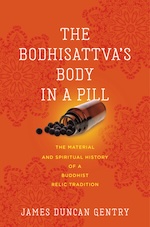

Today, we are happy to bring you our conversation with James Duncan Gentry, author of The Bodhisattva’s Body in a Pill: The Material and Spiritual History of a Buddhist Relic Tradition
What inspired you to write this book?
What inspired me to write this book is my observation that despite the ubiquity of consecrated relic pills in Tibetan Buddhist cultural settings—indeed, tiny baggies of such pills are distributed in even the most casual encounters with Tibetan lamas—there has been surprisingly little research examining this phenomenon and its importance in Tibetan societies. The maṇi pill emerged as a logical focal point for this study only after discovering that its contemporary appeal, due to the role of the current Dalai Lama in annually producing them, stretches all the way back to the formative period of Buddhism in Tibet, over one thousand years ago. The longevity of the maṇi pill tradition and its many transformations over time enabled a privileged vantage point, by my estimation, into the oft-neglected roles of material culture in the history of Buddhist tantra in Tibet.
What did you learn and what are you hoping readers will learn from your book?
Foremost, I hope this book can give readers a vivid sense of how important pills like the maṇi pill have been in the religious lives of Tibetan Buddhists of all walks of life, from the most high-profile monastic hierarchs to the wider population of lay devotees, particularly with regard to how esoteric ideas and practices of Buddhist tantra were integrated into mainstream Tibetan life. I also hope that the book conveys how and why so many of Tibet’s leading Buddhist intellectuals and visionaries have over the centuries cared deeply about the maṇi pill and promoted its production and consumption. On a broader level, I hope the book can impart to readers insights into how traditions like the maṇi pill have thrived over the ages in Buddhist societies through a dialectical interplay between tradition and innovation, carefully and strategically calibrated in timely response to changing social, religious, and political needs and circumstances. Such insights can, I believe, be instructive for how traditions are produced and reproduced over the ages in general, well beyond the Tibetan Buddhist context of the maṇi pill.
What surprised you the most in the process of writing your book?
One of the things that surprised me most about the process of writing this book is the interest expressed by Tibetan friends and colleagues in my research on the maṇi pill. Along similar lines, I was continually surprised by how vital the maṇi pill has been over the centuries in the Tibetan adoption and adaptation of Indian Buddhist tantra, and how seriously invested so many of Tibet’s leading spiritual figures were in promoting the production of maṇi pills or adopting it for their own institutions. In sum, it has been the intensive interest among Tibetans in the pill and its potential effects, sustained and rejuvenated repeatedly over the past one thousand years, that has been most eye opening.
What’s your favorite anecdote from your book?
Perhaps my favorite anecdote from the book is from chapter 2, which explores the rationale operative in the maṇi pill’s constitution and ritual consecration during its inaugural period in the middle of the thirteenth century under the auspices of Guru Chöwang. The chapter relates the pharmacological properties of the pill with vignettes from Guru Chöwang’s biographical corpus to illustrate that pill consecration and consumption was intended to produce in crowds the shared sensations of heightened energy, bodily purging, and vulnerability. These aspects of Guru Chöwang’s pill not only challenge the assumption that religious experience is necessarily private and individual. They also invite comparison with anthropological kinship theories, calling for us to interpret the shared sensations generated by the pills and their associated rituals as fostering a sense of kindred belonging thought capable of indexing rebirth in a pure land and addressing social fragmentation, epidemic, military threat, and other collective crises presumed to typify a Buddhist “degenerate age.”
What’s next?
During my research on Tibetan pill traditions, I discovered passages in early Great Perfection writings that prescribe the cultivation and consumption of psychoactive fungi as an integral part of the Buddhist path. In a forthcoming paper, I identity these passages as the first instances discovered in premodern Buddhist literature in which the use of psychedelics is unambiguously prescribed to hasten progress toward awakening. In so doing, I make two central arguments: one, that mounting scholarly consensus claiming premodern Buddhists never used psychoactive substances as part of Buddhist contemplative practice is in need of correction; and two, that the early Tibetan Great Perfection tradition and others that integrate medicine and meditation can serve as resources for investigating how premodern Buddhists envisioned the role of psychedelics in developing contemplative experience. The paper concludes with suggestions for how this and similarly focused text-historical research in Buddhist Studies might contribute to scientific research on the possible relationships between contemplation and psychedelics.
I am also deep into my next book project: a one-thousand-year history of literary arguments in Tibet over the authenticity of the Nyingma school of Tibetan Buddhism. My study illustrates that arguing for Nyingma authenticity against detractors became a defining feature of Nyingma sectarian identity that has endured into the present period. And yet, as I hope to show, arguments over Nyingma authenticity go well beyond attempts to define the boundaries and identity of any one sectarian tradition but have significant bearing on the challenges all societies face in their adaptation of Buddhist traditions.