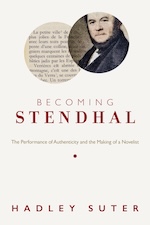

Today, we are happy to bring you our conversation with Hadley Suter, author of Becoming Stendhal: The Performance of Authenticity and the Making of a Novelist
What inspired you to write this book?
I actually didn’t read Stendhal until I got to grad school. He’s not as ubiquitous in undergrad French departments in the U.S. as the other two main French Realists, Balzac and Flaubert. I remember seeing his name on the syllabus and groaning — I was expecting to be bored. But then I remember sitting on the bus in LA with Le Rouge et le Noir and giggling the whole way home. My first year at UCLA I was determined to act like I was still living in New York, and I refused to get a car. So I came to Stendhal during rush hour, where it would take about three hours to go five miles.
Ultimately, Stendhal became a vessel to try to figure out what we mean when we talk about authenticity. I’ve always been drawn to stories of shapeshifter personalities, because they’re so destabilizing. Stendhal’s heroes are funny because they’re shapeshifters, but at the same time they believe and they’re more authentic than everyone around them. Theorizing paradoxes like this one revealed that the question really boils down to how the self relates to language. In my book I focus on the written word: I trace the original crisis of authenticity back to the creation of the alphabet in Ancient Greece. But more generally, as my colleague Ben Orlove at Columbia put it to me, it’s the fundamental question: Is speech externalized thought or is thought internalized speech?
What did you learn and what are you hoping readers will learn from your book?
What I learned is that we’ve been understanding authenticity all wrong – in terms of being true to yourself. This definition has reigned supreme not just in the worlds of literary criticism and philosophy, but in pop culture at large. We inherited it from Lionel Trilling, who in 1970 said that sincerity was being true to others, while authenticity was being true to yourself.
The problem with this definition is that it’s too vulnerable to the question, “But is there an inner self to be true to?” A lot of theorists and philosophers from the mid-twentieth century on would say absolutely not, because it’s proven basically impossible to even define what a “self” is in any universalist terms.
What I argue is that we can get around this roadblock by updating the definitions: Sincerity is faithfulness to a feeling; authenticity is faithfulness to an ideal.
So the question of if an inner self exists is secondary to the question of what an authentic self looks like in practice, or as self-help gurus might say, “as a practice.”
In this way, authenticity no longer risks becoming a moot point, and it has the potential to resist being completely cannibalized by today’s consumer culture. This is because there’s a moral caveat, which is that not all ideals are created equally. And so you can be authentically evil, or authentically ridiculous, if you’re choosing the wrong ideal. Authenticity is not an inherently virtuous pursuit. It becomes one only when a noble ideal is chosen.
What surprised you the most in the process of writing your book?
I was most surprised by how much the economy and selfhood are linked at any given point in history. Think about the cultural revolutions of the 1960s and the neoliberal era that followed. The deregulation of the self – of societal strictures and cultural norms – coincided with the beginning of the deregulation of the economy and the dismantling of the postwar social welfare state.
That was the seedling of an idea that led me to wonder if the same thing was going on in Stendhal’s era. Because as philosophers like Charles Taylor have demonstrated, in postrevolutionary France, where the old class order of the Ancien Regime had been abolished, the self was for the first time something to be created rather than inherited. And this was a change that stuck around even when the monarchy was restored.
So I turned to economic historians of the Bourse, to a French scholar named Paul Lagneau-Ymonet in particular, to learn about the regulatory tides of the Restoration and July Monarchy.
The short answer is yes: For much of the time that Stendhal is producing his greatest novels, there is a similar twinning tendency of deregulation. My fourth chapter is called “From Specie to Fiat,” and it maps the parallel shifts in the realms of the economy and of the self, from fixed entities of inherent value to representational currencies operating within a new system based on speculation and risk.
What’s your favorite anecdote from your book?
In Chapter 2, I look at a fake letter Stendhal wrote to publishers, where he explains that he’s recently finished Histoire de la peinture en Italie and asks them to announce it. Only he never sent the letter, and in fact he wrote it before he’d even finished the book.
Most Stendhalians have interpreted the letter as just him being kooky. But I like the anecdote because it’s a good illustration of how my notion of performative authenticity converges with philosopher Charles Larmore’s idea of the practical self: When you choose to believe something, you oblige yourself to behave in a way that corroborates the truth of that belief. It’s like a contract Stendhal is signing to himself to actually finish the book and publish it.
What’s next?
I’m working on a social biography of Mustapha Khayati, the Tunisian writer and social critic who was a member of the Situationist International and the main author of On the Poverty of Student Life, a pamphlet that helped spark Mai 68 in France.