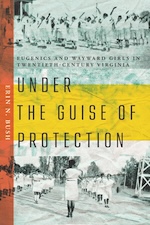

Today, we are happy to bring you our conversation with Erin N. Bush, author of Under the Guise of Protection: Eugenics and Wayward Girls in Twentieth-Century Virginia
What inspired you to write this book?
When I was a graduate student, I worked on a project researching capital punishment in Virginia. In 1912, the state electrocuted a Black juvenile domestic worker named Virginia Christian for the murder of her employer. The case drew media attention because Christian was seventeen at the time of her execution. Local and national civil rights advocates and African American reform associations publicly rallied for a commutation of her sentence, but Governor William Hodges Mann refused. The Virginia Federation of Colored Women’s Clubs, including Janie Porter Barrett, was particularly outspoken on behalf of Christian’s case. I read in a secondary source that Barrett used the Christian execution as a platform to rally support for a reformatory for delinquent Black girls. Barrett argued, according to the source, that a reformatory could both protect young Black offenders from the electric chair and teach young domestics how to behave to prevent workplace issues from escalating into violence. This spawned questions for me. Namely, would Virginia’s reform community even entertain the idea of reforming young Black offenders? Was it possible that such an institution could have saved Virginia Christian? I started looking into the history of the opening of the Industrial School for Colored Girls in 1915. In the archives, I found the admissions logs for this institution and the white reformatory. From there, I recognized a unique opportunity to compare two parallel, segregated, and uniquely Southern institutions in the Progressive Era. We don’t often get those opportunities.
What did you learn and what are you hoping readers will learn from your book?
Coming to the book, I already knew that progressive reformers used fear to get their reforms passed. The research process helped me understand why.
Virginia’s early twentieth-century reformers weren’t a unified movement of well-meaning advocates. They were a mixed coalition. Some were genuinely committed to improving lives. Others were opportunists who saw a crisis as a path to power. Others were true believers in ideas we now recognize as deeply harmful. Several blended elements of all these. What united them wasn’t benevolence but strategy: sensational events, lurid headlines, and alarmist language were tools for moving structures of power that were otherwise indifferent to suffering.
The eugenic metaphor was the most revealing piece of this puzzle. Framing reforms in the language of “racial fitness” and hereditary threat wasn’t incidental; it was the price of admission in Virginia’s political culture. But it was also, for some reformers, a genuinely held conviction.
I hope readers come away with a more honest understanding of how progressive reform actually worked. Reformers weren’t just principled advocates calmly persuading neutral audiences. They were people navigating hostile terrain, making strategic calculations, and wielding the cultural vocabulary of their moment, sometimes cynically, sometimes sincerely, and often both at once. That complexity has uncomfortable echoes today, and sitting with that discomfort is exactly the point.
What surprised you the most in the process of writing your book?
I had absorbed the comforting narrative that progressive reformers mostly stayed in their lanes: child welfare people did child welfare, labor reformers did labor, and eugenicists occupied a darker, separate corner of the landscape. I expected to write a tightly focused story about female delinquency and the institutions that claimed to save wayward girls.
Instead, eugenics language and rationales kept showing up in the archive, again and again, in places I hadn’t expected to find them, such as letters, probation and institutional reports, and reform programs. Reformers threaded eugenic ideas through all of it. The more I followed those threads, the clearer it became that eugenics wasn’t its own discrete agenda; it was a shared language that linked causes and camps we usually study apart.
I started writing a book about female delinquency and ended up writing a book about how eugenic thinking helped organize reform itself. I hope readers are similarly startled by how porous the boundaries between “good” and “bad” reform ideas are, and by how many familiar stories of progress rest on assumptions we’d now reject.
What’s your favorite anecdote from your book?
I love the sideways glimpses of people’s lives in the archives. Because I rarely had access to detailed personal narratives from the reformers or the girls themselves, I treasure the surprises I do find. Janie Porter Barrett, founder and longtime superintendent of the Virginia Industrial Home School for Colored Girls, noted repeatedly that she was invited to the weddings, church programs, and birthday parties of former inmates. That pattern of invitations quietly testifies to relationships that did not end at the gate.
At the Virginia Industrial School for Girls, another matron, Anna Petersen, taught herself to drive the farm’s resident red pickup truck so she wouldn’t feel quite so stranded. It is such a modest act of self-assertion, but it shifts her from a flat authority figure into a woman trying to carve out some mobility and independence in a lonely job.
The girls themselves appear in similar flashes: putting on skits, writing poems, improvising holiday “programs” out of almost nothing. My favorite anecdote, then, is really this accumulation of small scenes that insist these were complicated human beings—funny, resourceful, lonely, proud—living in a setting designed to make them all look the same.
What’s next?
Next, I’m returning to capital punishment, a topic that has haunted the edges of my work for a long time.
I’ve started a new project on two Georgia women convicted of murder in the 1870s, both entangled in love triangles. One was hanged; the other’s sentence was commuted. I’m using their cases to ask how ideas about femininity, the family, and the sanctity of romantic love shaped life-and-death decisions in the post-Reconstruction South. Why was one woman rendered unforgivable while the other remained, somehow, redeemable
It’s early in the research, but I’m excited about this project because it lets me stay with the questions that animate my current book. I’m still exploring how the state polices women, and also how reform and punishment intertwine, but now I’ve shifted to a different archive and a different corner of state power.