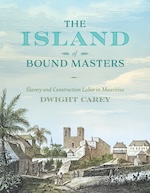
Today, we are happy to bring you our conversation with Dwight Carey, author of The Island of Bound Masters: Slavery and Construction Labor in Mauritius
What inspired you to write this book?
I decided to write this book because the architectural history of Mauritius is vastly understudied. Most often, when Mauritius appears in the scholarly literature, the island is discussed in terms of its history of slavery and colonialism. Recognizing the importance of this aspect of the Mauritian past, my book reveals how both architecture and building labor were essential for the development of the multicultural society of modern Mauritius. Architectural historians have long overlooked the islands of the Indian Ocean world. My book seeks to show how crucial island societies like Mauritius were for the growth of modern empires and modern Africa. There is also a tendency in North American and European academic circles to think of islands as marginal. My book shows how Mauritius was never on the sidelines. Mauritius was a crucial node, and architectural historians should focus more attention on this island as well as the other sites where creolization or cultural mixture unfolded and impacted the built environment and experiences of building labor. An approach to such histories could extend from the Indian Ocean to the Caribbean and into the Pacific. There are so many fascinating places around the world that have not been subjected to inquiry in architectural studies. It would be great if we moved beyond the most canonical of sites and began to investigate understudied societies to see what they can teach us. I wrote this book to explicate the importance of this point.
What did you learn and what are you hoping readers will learn from your book?
I learned that the work of engaging histories of construction labor is in fact a part of architectural studies. In general, architectural historians do not spend much time discussing the lives, ideas, and experiences of construction workers even though construction laborers are essential for the production of buildings. When I began the research for this book, I assumed that my project lay at the margins of architectural studies at best and that it was in fact an example of historical studies as a result of its extensive focus on materials from the colonial archive. The process of writing this book made me realize that my initial concerns were unwarranted. The Island of Bound Masters is an architectural history of Mauritius, I learned, and stories of construction work belong within the discipline. Construction labor studies is a subfield of architectural studies, I now firmly believe. I came to this realization after writing and re-writing this book and reading drafts of the manuscript over and over again. What emerges from this text is a history that is directly attuned to the relationships between buildings and people. Construction work is one of the most direct ways that human beings interact with the buildings that are a part of our world. I have learned that from writing this book. I hope that readers will gain an understanding of why we should spend more time discussing construction labor in contexts like Mauritius where few building vestiges remain intact.
What surprised you the most in the process of writing your book?
I was most surprised by how different the process of writing this book was from any other project that I have undertaken. I spent much of my time considering the overarching frame of the text, or what some people would call the “so what” question. In the introduction and in the conclusion, I articulate why the study of Mauritian slavery matters to people in Mauritius and around the world today. I was most surprised by how the history and the afterlife of enslaved construction labor in Mauritius made so much sense to me as someone who is an American descendant of enslaved people and an architectural historian who has spent time in Mauritius. The legacies of slavery felt so real and so connected to my own lived experience as well as the lived experiences of my friends and colleagues in Mauritius. I was surprised by how familiar yet how different histories and afterlives of Mauritian slavery and construction labor felt when comparing these paradigms to what has unfolded in the Atlantic world. Mauritius offers a distinct history of slavery with its connections to India, East Africa, Madagascar, and Southeast Asia, yet so many of the stories of labor, brutality, and resistance resonate with histories of bondage on the other side of the world. That is what makes Mauritius worthy of extended study—the island is both unique and connected to broader histories of enslavement and colonization worldwide.
What’s your favorite anecdote from your book?
That is a hard question to answer because this story has so many characters whom I will never forget. Perhaps I am most drawn to the story of Celestine, an enslaved woman who was a basket weaver in 1830s Mauritius. She entered into the historical record to report her owner to the Court of the Protector of Slaves, a body that the British created in Mauritius and other colonies for enslaved people to report cases of abuse in the era of abolition. Celestine told a detailed story about her labor, highlighting how she could sew as many as five baskets in one day while also watching over enslaved children in her workshop and supervising their work. Celestine really was a master of her craft. She was an enslaved basket weaver who knew how to plait the threads of the Vacoas, a Mauritian plant used to make baskets at the time, with such mastery that she could even aid the next generation as she completed her own exemplary work. In fact, Celestine’s owner praised her workmanship even as this figure of authority justified her denigration, her suffering, and her abuse. A story of masterful work and a complex comprehension of the material and morphological details of the Vacoas plant comes out of Celestine’s case before the Court of the Protector of Slaves. I was honored to be able to bring this brief account of Celestine’s life into The Island of Bound Masters.
What’s next?
My new book is next for me! I am currently working on a project on the material culture of exile in Seychelles, an Indian Ocean archipelago about 800 miles off of the coast of East Africa. From 1877 to the 1950s, the British sent elite, anti-colonial political dissidents from across the empire into exile in Seychelles. My next book is a study of these exiles and the objects that they owned. I investigate how these objects can help us understand the history of political imprisonment and modernity in Seychelles and across the British empire. Exiles came to Seychelles from Ghana, Cyprus, Palestine, Egypt, Uganda, Tanzania, Malaysia, and even Ireland. My goal is to study all of these exiles and piece together what the material culture of their political imprisonment can tell us about their experiences as well as the development of Seychelles and Afro-British relations. My goal is to make progress on this project next year. I am already drafting an article that is based upon the research that I conducted in Seychelles and London in the summers of 2025 and 2026. I also have an idea for another project on the contemporary architecture of the small, postcolonial island states of the Indian Ocean. That project is inchoate at this point, but it is something that I would like to explore in the coming years. Overall, I am eager to continue my examination of the understudied island societies of the Indian Ocean world.