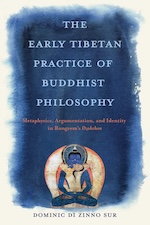

Today, we are happy to bring you our conversation with Dominic Di Zinno Sur, author of The Early Tibetan Practice of Buddhist Philosophy: Metaphysics, Argumentation, and Identity in Rongzom’s Dzokchen
What inspired you to write this book?
Because studying the eleventh/twelfth century work of Rongzom Chokyi Zangpo (also known as the translator, Rongzom), I realized he and his dzokchen philosophy were both ground-breaking and extraordinary, both in Tibet and in the broader history of Buddhism.
What did you learn and what are you hoping readers will learn from your book?
That the indigenous Tibetan practice of Buddhist philosophy, which is something beyond the transmission of Buddhist philosophy, is documented in Entering the Way of the Great Vehicle, Rongzom’s polemical defense of the authority and validity of Tibet’s own dzokchen style of Buddhism.
What surprised you the most in the process of writing your book?
Rongzom’s humor, erudition, intellectual honesty, and cunning. Sometimes he uses his remarkable metatheoretical mastery of Buddhist logic and doctrine to form arguments that work in purely rational terms, using chains of related ideas that lead to what is arguably an inevitably obvious outcome, as one would suspect of a great philosopher. At other times, he puts that knowledge to work in constructing arguments that hammer as much on emotional allegiances as they do on intellectual allegiances. Some of his arguments simply dare interlocutors.
What’s your favorite anecdote from your book?
Rongzom’s text is almost a thousand years old. It is the very last text a monk or nun studies in the monastery. Cleary, the text is crucial to the Nyingma sect. Yet, until recently, there was never any traditional commentary on it; and there was almost no mention of it in other texts for more than 800 years after its composition. Recently, I observed two Tibetan scholars debate (vehemently disagree!) about the meaning of the title. This type of critical exchange about scripture––debate and disagreement, which works for, not against, Tibetan Buddhist culture––is something I have always admired.
What’s next?
I’ve just finished translating a 15th century dzokchen commentary on a 12th century poem entitled A Framework for Vehicles (theg pa spyi bcings) under the auspices of Tsadra Foundation. I am currently preparing that translation for publication while working on a history of Nyingma tantric logic.