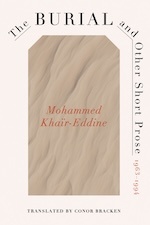


Today, we are happy to bring you our conversation with Conor Bracken, translator of The Burial and Other Short Prose, 1963-1994 by Mohammed Khaïr-Eddine
What inspired you to translate this book?
Community is what inspired me to translate this book. After the publication of my first translation, I struck up a friendship with a scholar of Khaïr’s work, who recommended I get all that I could from William Blake & Co., the publisher of this collection as well as Khaïr’s final journals. Reading the stories and short essays in L’Enterrement, I found flashes of the Khaïr of “Le Roi” and “Soleil arachnide,” long surreal poems responding with bile and erudition and abject shrieks and vigor to King Hassan II’s Years of Lead. But I also found more of the Khaïr of “Nausée noir,” the long meditative, imagistic opening sequence of that book, that is more tonally controlled and in restrained awe of the arid desert landscape of Southern Morocco, reinvesting it with life and respect while resisting the colonial/extractive imposition that the desert is a ‘terrain vague’ or wasteland. The urban and the rural, the exile and the prodigal returned, the swaggering boaster and the patient thinker—they’re all here, and when I reached out to Jean-Paul Michel to express my interest in translating the collection, he was so generous and so kind, I sped up my efforts that match the pitch of his enthusiasm. Translation is so much about building relationships, between cultures, languages, time periods, and epistemologies, of course, but also people who love the work of writing, publishing, sharing it all with readers. I’m glad to have been able to do that once again here.
What did you learn and what are you hoping readers will learn from your book?
I learned a different side of Khaïr in this book—plainspoken, sometimes tender, full of appreciation, if not wonder, at the place he is from as much as he’s full of contempt for those who have sought to transform it into fiefdoms or cheap folklore. For me, many of the poems of his I’ve translated were ferocious and denunciatory, and some of the pieces here channel that same energy (like “The Hashshashins, and “Two Cutthroats” to a degree), but there are others here that tap into a deep seam of robust, fulfilling from-ness, a connection to the land and the people who abided upon it, that nourished him. It is the source of his brilliance and his commitment, and anyone who threatened or reviled it became a target of his erudite and polydactyl vituperations. I hope readers can find here how much Khaïr loved his people and his region. It is not a sentimentalizing, dewy-eyed love that suffuses it all with an uncanny, sappy glow, but the kind of love that recognizes the effort and wisdom it took to survive the difficult conditions, both social and environmental, of southern Morocco. The kind of love, like James Baldwin’s of America, that obligates one to criticize as much as embrace, so that it might become all that it has the promise to be.
What surprised you the most in the process of translating this book?
The thing that surprised me most when translating this book was how, even in the midst of arguably conventional, straightforward prose, Khaïr was still ready and able to switch directions on a dime. Translating his poems can feel, at times, like trying to saddle a torrent—so much raw thrashing power, surging up in sheaves of images and torqued idioms and recondite botanical knowledge, it’s all you could do to just keep your head pointed in the right direction. Here, in most of these pieces (“The Burial” and “The Hashshashins” in particular excluded), the pressure on the language is dialed way down, and the unit of meaning isn’t the line—it’s the sentence, the paragraph, the page. The pace is more languid. But even so, Khaïr toggles between lexical registers, going from understated noir to venomously vatic in half a page. He can move from talking about extinct sauropods towering over quavering mammalian ancestors to an illiterate warlord reminiscing on the patio of his citadel about the bloody lawless times of the Seïba. I love that about Khaïr’s work, its vigor and willingness to turn suddenly, but meaningfully. Even in his later prose, he still had access to that gearbox, but moved through the gears with a different kind of urgency.
What’s your favorite piece in this book?
There’s much to enjoy and be educated and baffled by, from the gory historical fiction of “Two Cutthroats” showing us how the mountains in the south were pacified from within, to the sparkling demonology of “On Djinns and Men” or “A Ghoul,” or the feverish mashup of medieval political intrigue giving onto hallucinatory noir in “The Hashshashins”—as I mention above, one of the things I love about Khaïr’s work is how quickly it can dive into something entirely different. But the piece that I think that does that most surprisingly, most enjoyably, most lightly and delightfully for me is “Reptiles.” We start millions of years ago, with the gigantomachy of dinosaurs, and end with a Sufi saint claiming “I am the serpent, I change my skin regularly though it is my soul which improves” as he places a large stone on his stomach to quiet his hunger spasms. There’s ouroborian quality to it, the piece eating its own tail (or tale?), which feels especially meaningful since in the middle of the piece we meet a cutthroat who came into wealth and comfort during the Seïba because he was well-armed and willing to kill. How cyclical is the struggle for power? How indelibly is violence encoded into the world, in its geological and political origins? What, if anything, can spring us free from this pattern of domination and subordination? One thing, Khaïr suggests, is story, especially orally transmitted story, because not even empire can grab hold of or burn that.
What’s next?
At the moment, the immediate next thing is to finish up my second book of poems. It’s titled All-American Dad and it’s attempts, via satire and persona and occasional confessional poems, to strip the hypertrophied manospheric absurdities from fatherhood in order to arrive at a masculinity worth giving to my kids as we navigate this age of ecological collapse and capitalist monstrosity. Beyond that, I’m hoping to start translating a book of poems by Yoann Thommerel that’s part crowdsourced cookbook for feeding oneself on the cheap, part choral poem sung by the voices of a neighborhood on the margins, and overall a cross section of what contemporary Frenchness is, in food, in social belonging, in what survives assimilation. One thing I’d really like to do as well is find a home for a novel I’ve begun translating, by the artist and writer Sinzo Aanza. It’s titled Genealogy of an Everyday Thing and it is also a choral endeavor, though it’s a book in five voices who are all telling different facets of a story about a neighborhood in eastern Congo that has turned itself into an open copper mine. It’s a really incredible book, with complicated characters who generally fail Kelefa Sanneh’s ‘pervert test’ but whom you find yourself rooting for anyway, and who are all asking us to think about what the relationship between state and citizen should be in times of corporate capture and enduring neocolonial extractive capitalism.


