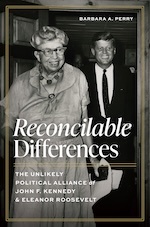
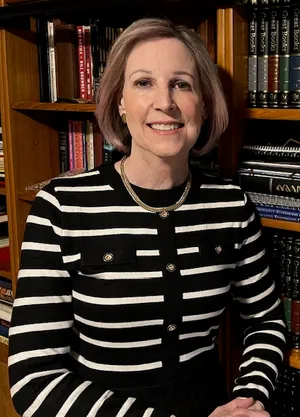
Today, we are happy to bring you our conversation with Barbara A. Perry, author of Reconcilable Differences: The Unlikely Political Alliance of John F. Kennedy and Eleanor Roosevelt
What inspired you to write this book?
My mother turned me into a president and First Lady scholar at the age of four, when she took me and my brothers to see Senator John F. Kennedy when he was campaigning for the presidency in 1960. Thus, my fascination with him and the Kennedy family is nearly lifelong. During my first visit in 2010 to Val-Kill, Eleanor Roosevelt’s home at Hyde Park in upstate New York, I came upon a photo of Mrs. Roosevelt and JFK, smiling broadly as they visited at her cottage just after he garnered the Democratic nomination for president. What was the back story of this photo, I wondered. My book follows the intriguing relationship between two of America’s most powerful political dynasties, sometimes allied and sometimes clashing, and how the future president and former First Lady found common ground to launch a women’s rights movement once Eleanor helped Jack win the White House.
What did you learn and what are you hoping readers will learn from your book?
I learned and I hope readers will, too, that despite differences over foreign and domestic policy, even within the same political party, opponents can forge alliances that can help them solve social and economic problems if they can find room for compromise. Mrs. Roosevelt’s admirable progressivism toward women, minorities, and labor developed over decades of experience in the public arena. Yet her name never appeared on a ballot for elected office, so she had the luxury of following her principles. On the other hand, Kennedy had to find moderate positions on social issues, especially civil rights, so that he could earn the support of the Democratic party’s southern wing. As a Yankee and Roman Catholic, he already had two strikes against him in the Protestant “Bible Belt” below the Mason-Dixon Line, so he could ill afford to side with Eleanor on expansive civil rights for Black Americans in the 1960 campaign.
What surprised you the most in the process of writing your book?
The book opens by setting the scene for the dramatic Val Kill meeting between Mrs. Roosevelt and Senator Kennedy in August 1960. What stunned me as a I learned more about the lead-up to their crucial conversation was that two days earlier Eleanor had lost her beloved 13-year-old granddaughter, Sally, in a horseback riding accident at a summer camp. No stranger to family tragedies, JFK let Eleanor know that he did not want to impose on her at such a difficult time. She responded that she knew how full presidential candidate’s schedules were, and Kennedy should join her in Hyde Park as they had planned.
What’s your favorite anecdote from your book?
Despite the diplomacy Mrs. Roosevelt displayed as a U.S. delegate to the United Nations, her disdain for the 41 year-old senator was obvious when she addressed Jack Kennedy in a 1958 telegram as “My Dear Boy.” Nevertheless, he always treated her with respect, addressing her as “Mrs. Roosevelt,” even after becoming president. For an experienced politician, descended from tough pols on both the Kennedy and Fitzgerald sides of his family tree, JFK almost seemed a tad naive in once asking a friend of Eleanor, “Why doesn’t Mrs. Roosevelt like me?” In addition to their policy differences, I observe that perhaps the former First Lady saw a bit too much of her unfaithful husband in the playboy image of young Jack Kennedy.
What’s next?
At UVA’s Miller Center, I am now leading the Joe Biden Presidential Oral History Project, which is a fascinating endeavor. My next book is inspired by recent speaking engagements I’ve had in Ireland and England. The working title is “President John F. Kennedy’s Triumphant European Tour: How JFK Found His Roots, Embraced His Religion, and Led the Free World.” It focuses on his summer 1963 sojourn to Germany, Ireland, England, and Italy and encompasses his historic speech about the Berlin Wall, his visit to the Kennedy Homestead in County Wexford, his summit with British Prime Minister Harold Macmillan, and his meeting with the new pontiff, Pope Paul VI, at the Vatican.