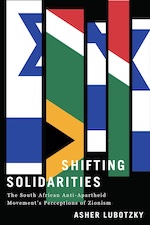

Today, we are happy to bring you our conversation with Asher Lubotzky, author of Shifting Solidarities: The South African Anti-Apartheid Movement’s Perceptions of Zionism
What inspired you to write this book?
There was a striking gap in the historiography. The story of Israeli–South African relations has usually begun in the 1970s, when Israel developed close ties with the apartheid regime. At the same time, histories of Israel’s engagement with Africa have focused overwhelmingly on the 1950s and 1960s while paying remarkably little attention to South Africa. Historians of Israeli-African relations rarely discussed South Africa, while historians of South African-Israeli relations rarely looked seriously at the period before the 1970s.
Yet there were clues suggesting that something important had happened during those missing decades. I discovered a much richer and more complicated story than the conventional narrative suggested. I found evidence of contacts, debates, sympathies, and disagreements involving South African anti-apartheid activists, South African Zionists, Israeli officials, and other liberation movements long before the period that historians typically emphasize.
I was also intrigued by the intensity of anti-Zionist sentiment within the anti-apartheid movement in recent decades. That raised a simple question: if these views seem so self-evident today, were they always held in the same way? We know from many other cases — including the Black civil rights movement in the United States — that political movements’ attitudes toward Israel changed dramatically over time. I wanted to understand whether a similar transformation had occurred in South Africa, how it happened, and what it could teach us about the formation of political solidarities more generally.
The result was a project that not only filled a historiographical gap but also challenged many assumptions about the history of South Africa, Israel, and the global politics of liberation.
What did you learn and what are you hoping readers will learn from your book?
One of the most interesting lessons I learned was how differently historical actors understood Israel, Zionism, and Palestine at different moments in time. Today, these issues are often viewed through fixed political categories, but the people I encountered in the archives did not experience them that way. The same individuals and movements could interpret Israel as a model of national liberation, a partner in anti-colonial struggle, a colonial project, or even an enemy, depending on the historical context.
The research also reminded me of the importance of looking beyond retrospective narratives. Many of the assumptions we hold today about the relationship between South Africa’s liberation movements and the Palestinian cause only became firmly established after a long and contested historical process. The archival record reveals a much more fluid world, full of debate, uncertainty, and unexpected encounters.
I hope readers will come away with a deeper appreciation for how political ideas travel across borders and how global solidarities are constructed. The book is ultimately about South Africa and Israel, but it is also about the ways people make sense of distant struggles and incorporate them into their own political visions.
More broadly, I hope readers discover that history is rarely a straight line. The paths that seem obvious in hindsight were often anything but obvious to those living through them, and recognizing that complexity can help us better understand both the past and the present.
What surprised you the most in the process of writing your book?
What surprised me most was how thoroughly an important chapter of history had been forgotten. The book uncovers relationships, conversations, and even forms of cooperation that involved dozens of activists, diplomats, and political leaders. Yet when I began researching the topic, very little of this history remained in public memory.
What makes this especially fascinating is that the amnesia was not accidental. Both sides had reasons to forget. For many South African anti-apartheid activists, later solidarity with the Palestinian cause became so central to their political identity that earlier sympathies toward Zionism or contacts with Israel faded from the narrative. For Israelis, meanwhile, the story sat uneasily alongside Israel’s later (and important, at the time) relationship with apartheid South Africa. As political realities changed, memories changed as well.
The deeper I went into the archives, the more examples I found of people who had once spoken warmly of one another but later preferred not to mention those connections. It was a reminder that history is not only about what societies choose to remember, but also about what they choose to forget.
As a historian, I found that both surprising and exciting. The archives revealed a world that had largely disappeared from public consciousness, even though it helped shape political attitudes that remain influential today. It is a good thing that archives do not forget, even when people do.
What’s your favorite anecdote from your book?
One of my favorite anecdotes involves the Pan Africanist Congress (PAC), a militant anti-apartheid movement that approached Israel in the early 1960s seeking support for its struggle against apartheid. At first glance, this might seem surprising given the PAC’s later reputation as a staunch supporter of the Palestinian cause. But what fascinated me was the way the PAC framed its appeal.
Rather than simply arguing that Israel should support them out of moral obligation or anticolonial solidarity, PAC representatives offered a much more creative argument. They warned that South African Jews could eventually become victims of the apartheid system themselves and suggested that supporting African liberation was therefore in Israel’s own interest. In effect, they proposed a bargain: help us liberate South Africa, and we will help protect South African Jewry.
What I find so striking about this episode is the reversal of the usual donor-recipient relationship. Liberation movements are often portrayed as passive recipients of international aid, appealing to wealthier or more powerful actors for assistance. The PAC’s argument was different. It presented Africans not as victims asking for charity, but as future protectors capable of safeguarding others. Support for the anti-apartheid struggle was framed not as a favor to Africans but as an investment in a shared future.
That small episode captures something I encountered repeatedly while researching the book: African nationalists were not merely reacting to global politics. They were actively reshaping the terms of international relationships and insisting on their own agency within them.
What’s next?
I currently have two major projects in mind, both of which build on questions that emerged while researching Shifting Solidarities.
The first is a history of anti-Zionism in South Africa. Rather than treating anti-Zionism as a single ideology, I am interested in tracing its diverse and sometimes contradictory roots within South Africa’s multiracial society. White supremacists, Marxists, Islamists, Black nationalists, and other political currents often opposed Zionism for very different reasons and with very different goals. Exploring how these distinct traditions developed, interacted, and occasionally overlapped would offer a richer understanding of both South African political culture and the global history of anti-Zionism.
The second project examines the experiences of Israeli migrants and long-term visitors in South Africa. Thousands of Israelis have lived, worked, traveled, and built communities there over the decades, yet their history remains largely unwritten. I am particularly interested in how they encountered and interpreted apartheid, how they navigated the transition to democracy, and how life in South Africa shaped their own views of identity, race, and politics – and their views of the land they left behind.
Both projects continue my broader interest in encounters between South Africa and Israel, and in the ways people construct, challenge, and remember political solidarities across national boundaries.