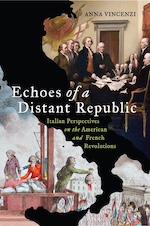

Today, we are happy to bring you our conversation with Anna Vincenzi, author of Echoes of a Distant Republic: Italian Perspectives on the American and French Revolutions
What inspired you to write this book?
Believe it or not, the very beginning of this project was my undergraduate thesis, so I’ve been working on the topic on and off for 15 years. A professor at the university I attended in Milan one semester decided to teach a seminar on colonial and revolutionary America, closing the semester with long excerpts from Tocqueville’s Democracy in America. I was captivated. The class raised fascinating questions about the nature of freedom: what does it mean to live as free men? And how does one achieve that? What kind of political system favors that? That was the beginning of my interest in the American Revolution. I asked that professor to advise my undergraduate thesis, and started working on how Italian newspapers reported on the American Revolution. I eventually moved to the US and started a PhD at the University of Notre Dame, working with Patrick Griffin, and that project grew into a PhD dissertation and then a book. Newspapers are only one of the different kinds of sources that this book considers, but those questions that initially sparked my interest remained central to the project and are central to this book.
What did you learn and what are you hoping readers will learn from your book?
On the surface, the book tells the story of how the people of the Italian states interpreted the American Revolution during the 1770s and 1780s, and then how the outbreak of the French Revolution prompted a revision of those early interpretations.
The deeper story is one about how the very concept of “revolution” was revolutionized by the events of the French 1790s. The modern notion of revolution—understood as a radical social and political change, with potentially global scope, that would usher in a new age in human history, and closely bound to ideas of democratic republicanism—emerged only later. The American Revolution, which was initially interpreted by most in Italy (and, arguably, Europe) as an episode in a broader Age of Reform, which was trying to address very real problems afflicting the Old Regime but not to destroy it, came to be seen as a “revolution” in the modern sense of the term only later on—as an effect of a process of retrospective reinterpretation prompted by the events of the French Revolution. That is how the idea of an “Age of Revolution” emerged and, with it, the idea that the American Revolution was the beginning of it and the “mother” of the French Revolution. And my book’s conclusion suggests that this happened in America as in Europe: people started to view the American Revolution as a much more revolutionary event than it had been and that its main protagonists and leaders had wanted it to be.
What surprised you the most in the process of writing your book?
The process of working on this topic over the past 15 years was, in many ways, a process of submitting my reason to reality and to what the sources were showing to me—which in the end is all that a historian does. At the very beginning, I “assumed” the Age of Revolution. I assumed that America must have inspired revolution in Europe. I mean, you have an American Revolution in North America, with lots of Frenchmen fighting in it, and then they go back and a few years later there’s revolution in France, and then revolution breaks out in Italy, and republics are set up across the peninsula, calling themselves “sister republics”… of course there must be a connection. News coming from America must have generated revolutionary fervor in Europe. That is what I expected to find at the beginning of my research.
But then I came across more and more sources that were telling a different story. At the very least, they were not expressing that “revolutionary” excitement which I took for granted (unknowingly also taking for granted that the word “revolution” always meant what we, moderns—in many ways, children of the Age of Revolution—mean by it). And so I started conceiving of the possibility that maybe there was an alternative story, which our modern assumptions tend to conceal.
What’s your favorite anecdote from your book?
There’s a quite funny source I discuss at some point in the book: a text by a Neapolitan Enlightenment thinker who, like many in Europe, in the 1780s was wondering whether the new republic would last, and actually expressing skepticism that it would. He expected Americans would soon start arguing among each other and the new republic would quickly descend into chaos. He gave the new republic 25 years max. He thought the American legislation hadn’t set up strong enough provisions against centrifugal impulses. And so he put forth his proposal: that Americans would give themselves a king, taking it from where? Americans would never be able to come to an agreement on one of them, he speculated, and so they should take a guy from a distinguished European family and make him king of America.
I thought the proposal was bizarre, and very interestingly so! One might expect someone like Fortunato Bartolomeo De Felice (this was the guy’s name)—a former Franciscan friar who, struggling with celibacy, had fled to Switzerland with a woman, converted to Calvinism, and, from his Swiss refuge, kept in contact with Neapolitan Enlightenment thinkers and freemasons—to be enthusiastic about the American experiment of republicanism and democracy. His calling for Americans to import a king from Europe is a somewhat hilarious anecdote that suggests that there might be an alternative story to be recovered from the usual one about how the great revolutionary movements of the “age” were ideologically interconnected.
What’s next?
My current research project represents a significant chronological jump from my earlier one, though I actually see deep continuity between the questions that shaped my research on the Age of Revolution and this new project.
Upon conclusion of my PhD, I was hired as Assistant Professor of Modern European History at Hillsdale College. Teaching and conversations with students and colleagues, particularly about Nineteenth- and Twentieth-Century Europe and about the relationship between Christians and modern liberal politics and pluralistic society, prompted my new research and book project on Christian Democracy at the beginning of the twentieth century, before the rise of Fascism in Europe. The main figure on whom I’m focusing is Luigi Sturzo (of whom I’ve written here): a priest and founder of the Italian Popular Party, which, though a-confessional, took inspiration from the social doctrine of the Catholic Church. Sturzo spent 20 years in exile after Fascism came to power.
In many ways, Sturzo’s generation—one century later—was still grappling with the questions generated by the Age of Revolution: how to relate to the new political systems and doctrines that it had brought about, and what it meant to live as free men. Sturzo was reacting to the “counterrevolutionary” tradition whose genesis I trace in the third section of Echoes of a Distant Republic. His generation was still dealing with the trauma of the Age of Revolution, as well as with the new prospects for revolution that it had generated—in both its Marxist-inspired version, the Russian Revolution, and its right-wing version, the revolutions brought about by various fascist regimes. They were still debating what it means to live as free men, and what role politics and political change could have in bringing about a truly “free” society.
Ultimately, therefore, I see great continuity between these two projects. And, really, I’m still working on the questions that inspired me as an undergraduate student reading Tocqueville 15 years ago.